Have you ever looked at something and wondered, “How long is 7 inches, really?” It’s one of those measurements that sounds simple on paper, but without a ruler nearby, it can be surprisingly hard to picture.
Seven inches is equal to about 17.8 cm, which puts it in a very useful middle ground not tiny, but not especially large either.
A measurement becomes much easier to understand when you can connect it to something you already see or touch every day. A standard pencil, a kitchen utensil, a small piece of fruit, or a familiar household tool can become a quick size reference.
That’s why everyday objects are so handy when trying to visualize length, even when their exact dimensions vary a little.
This guide looks at 13 common things that are 7 inches long or come very close to that measurement. Some examples are useful for cooking, some for writing, gardening, technology, and even simple DIY work.
They are not all manufactured to exactly 7 inches, so think of them as practical 7 inch reference objects, not laboratory-grade measuring instruments.
How Long Is 7 Inches?
Seven inches equals approximately 17.8 cm. If you have a standard ruler, simply locate the 7-inch mark and you’ll get the most accurate visual understanding of the length, obviously.
But what if you don’t have one? That’s where familiar objects can help. Comparing an unknown item with something whose approximate size you already know can provide a surprisingly useful form of visual length estimation.
For quick mental estimation, imagine a length a little shorter than the long side of a sheet of letter paper. Seven inches is also considerably longer than a typical smartphone’s width, while being close to the length of some smaller handheld tools.
The key word here is “approximately.” Everyday products aren’t always made to identical dimensions, so measurement comparison works best as a practical guide rather than an exact scientific test.
13 Common Things That Are 7 Inches Long
The following examples give you an easy way to understand things that are 7 inches long. Some are very close to 7 inches, while others can have versions or dimensions around this size.
1. Butter Knife
A typical butter knife can be around 7 inches long from the tip of the blade to the end of the handle. The exact length depends on the design, but many compact table knives fall close to this range.
A butter knife is a particularly useful 7 inch household item because it is something many people already have in their kitchen. Hold one beside a ruler and you may notice how naturally it gives you a sense of 7 inches.
It also demonstrates why the overall length matters. The blade alone might be much shorter, while the handle adds several more inches. So when comparing objects, always measure from end to end.
2. Small Banana
A small banana can measure around 7 inches from one end to the other. Bananas are naturally variable, though, so one fruit might be noticeably shorter or longer.
This makes a banana a fun 7 inches example for children learning measurement. You can place a banana beside a ruler and turn the activity into a simple lesson about centimeters and inches.
For food photography or portion-related activities, visual comparisons like this can also make dimensions easier to communicate. Still, don’t expect every banana at the grocery store to politely measure exactly 7 inches, because fruit doesn’t really care about our rulers.
3. Standard Pencil
A standard pencil is another familiar object that can help with visualizing length. Many pencils are around 7 inches long when new, although their dimensions vary by brand and style.
A freshly sharpened pencil can be slightly different from a brand-new unsharpened one, and a heavily used pencil may be much shorter. That’s actually useful for understanding approximate length.
For students, teachers, artists, and anyone involved in writing or drawing, a pencil gives a convenient tactile reference. You can quickly compare another object against it without reaching for a measuring tape every single time.
4. Crayon
A typical crayon is considerably shorter than 7 inches, but some larger art crayons, craft sticks, and extended drawing materials can approach this length. Because crayons come in many sizes, they should be treated as a variable reference rather than an exact 7-inch object.
The bigger lesson here is about standardization. Not every object in the same category has the same dimensions. When searching for objects that are 7 inches, always check whether the listed measurement refers to the object’s length, width, height, or diagonal.
For classroom tactile learning, however, different-sized crayons can still be useful for demonstrating how measurements change.
5. Garden Trowel
A compact garden trowel may measure close to 7 inches in total length, especially smaller hand trowels designed for containers or indoor gardening.
The tool is a great example of how ergonomics influences everyday object dimensions. Manufacturers need to balance grip comfort, portability, strength, and usefulness.
A trowel that is too short can feel awkward, while one that is too large may become inconvenient for small planting jobs.
If you’re doing gardening or home improvement, having a familiar tool near this size can provide a quick visual estimate when you’re working without precise measuring equipment.
6. Wooden Ruler
A wooden ruler is one of the easiest ways to understand 7 inches because it is specifically designed for measurement. A typical ruler may be 12 inches long, meaning 7 inches is a little more than half its total length.
If you’re teaching children about inches to centimeters, a ruler provides both systems in many cases. The 7-inch mark corresponds to approximately 17.8 centimeters.
Unlike an improvised reference object, a ruler is a proper measurement tool, so it should be your first choice whenever accuracy matters. Everyday objects are great for estimation, but they should not replace a measuring instrument for important DIY or construction work.
7. Golf Ball and Small Accessories
A golf ball itself is only around 1.7 inches in diameter, so it is not 7 inches long. However, several golf-related accessories, handles, or small training tools can approach the 7-inch range.
This example is worth including because it shows an important part of size comparison: a collection of smaller objects can help your brain understand a larger distance.
For example, imagining several golf balls lined up side by side can give you a rough sense of a longer measurement. It’s not a precision technique, but it is a playful form of mental estimation.
8. US Quarter Coins Placed Together
A single US quarter is only about 0.96 inches across, so one quarter certainly isn’t a 7-inch object. But placing several quarters side by side creates a visual measurement reference.
Seven quarters lined up by their diameter would give a little under 7 inches, making them useful for understanding the approximate scale. This is especially helpful when demonstrating hands-on measurement.
Coins are convenient because their dimensions are standardized. Unlike bananas or handmade objects, a US quarter has a consistent diameter, which makes it a better reference for repeated comparisons.
9. Compact Spatula
A small spatula can be close to 7 inches long, particularly compact kitchen models designed for baking, decorating, or working with smaller pans.
A spatula is another practical 7 inch kitchen item because you can find many different shapes and sizes. Some are much longer, while others are designed specifically for detailed food preparation.
An offset spatula is especially interesting because its shape may make it feel longer or shorter than it actually is. This is a good reminder that visual appearance doesn’t always equal measured length.
10. Offset Spatula
An offset spatula used for baking and cake decorating can come in lengths around 7 inches. These tools are designed with a bent or offset blade, which helps the user spread frosting or lift delicate foods more comfortably.
The design shows how ergonomic design affects an object’s usefulness. Two utensils can have nearly identical lengths but feel completely different in the hand because their handles, angles, and weight distribution are different.
For bakers, a compact spatula around 7 inches can be a handy size for decorating smaller cakes, cupcakes, and pastries.
11. Compact Kitchen Knife
A small kitchen knife or utility-style knife may have an overall length close to 7 inches, although knife dimensions vary widely. Some models are much longer, so this should be viewed as an approximate reference.
When measuring a knife, be clear about whether you’re measuring the blade or the entire object. A blade might be described as 7 inches while the complete knife is considerably longer.
That distinction matters whenever you’re researching 7 inch items, because product measurements often refer to only one component. The little details can change the answer quite a lot.
12. Small Handheld Tool
Various compact hand tools used for DIY projects can fall around the 7-inch range. A small screwdriver, scraper, handle, or craft tool may provide a useful reference depending on its particular design.
Tools are especially interesting because their size is often influenced by the task they’re meant to perform. A compact tool needs to be easy to hold, transport, and control.
If you’re trying to estimate 7 inches during a home project, however, don’t rely completely on a random tool. Grab a ruler or measuring tape if the measurement affects cutting, drilling, fitting, or installation. Guessing is charming until the shelf doesn’t fit.
13. Smartphone-Related Size Comparisons
Modern smartphones are useful for visual measurement, but they need to be handled carefully because their dimensions differ significantly between models.
For example, some larger smartphones have a height of around 6 to 7 inches, making them useful for understanding the general scale of this measurement. But a specific phone should always be checked by model rather than assumed to be exactly 7 inches.
This is especially important because people often confuse screen size with the physical length of the device. A phone advertised with a certain screen measurement is usually describing the screen’s diagonal, not its overall height.
7 Inches Visualized With Everyday Objects
If you’re asking what is 7 inches long, the easiest answer isn’t always a number. Numbers tell you the measurement, but familiar objects help your brain actually picture it.
Think of 7 inches as approximately 17.8 cm. Now imagine placing a few familiar objects beside that length. A small banana, compact kitchen utensil, pencil, or handheld tool can make the distance feel more real.
This kind of visual estimation is useful in ordinary situations. You might be shopping online and trying to judge whether a tool will fit inside a drawer, planning a craft project, checking the approximate size of a food item, or explaining measurements to a child.
Your brain is constantly making these little comparisons anyway. Giving it recognizable reference points just makes the process easier.
How to Measure 7 Inches Without a Ruler
Sometimes the ruler has disappeared into the mysterious household dimension where missing socks live. In those moments, you can still make a rough estimate.
One method is to use a familiar standardized object. A US quarter, for instance, has a known diameter, so several placed in a row can create an approximate length.
Another approach is to use an object you know is close to 7 inches, such as a suitable pencil or kitchen utensil. Place the unknown object beside it and compare both ends.
You can also use your hand as an improvised ruler, but this is less reliable because everyone’s hand size is different. Your palm, fingers, and thumb can provide rough visual clues, but they should not be considered precise measurement tools.
For accurate work, use a physical ruler or measuring tape. That’s what they’re there for, after all.
Why Knowing What 7 Inches Looks Like Is Useful
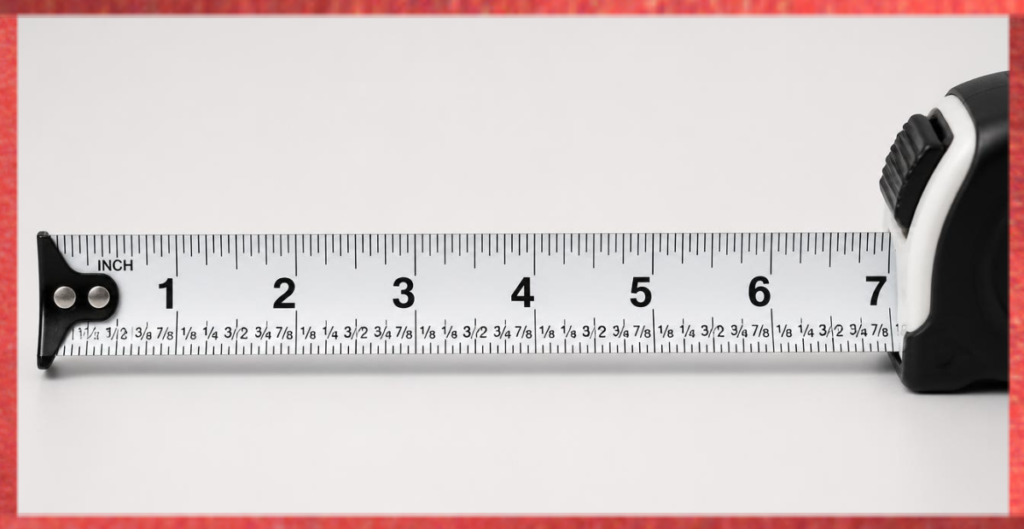
Understanding 7 inches in centimeters is more than a random measurement trick. It helps develop practical measurement awareness.
In education, students can learn the relationship between inches and centimeters through physical objects rather than memorizing numbers alone. Touching, comparing, and measuring objects creates a stronger connection between an abstract number and real-world size.
In cooking and baking, approximate size references can help with utensil selection, food preparation, and presentation. In gardening, knowing the approximate length of tools can make storage and workspace planning easier.
For DIY projects, visual measurement can help you quickly estimate distances before making a more precise measurement. And when shopping online, understanding dimensions can stop you from accidentally ordering something much larger or much smaller than expected.
7 Inch Size Comparison: What Feels Similar?
A 7 inch size comparison becomes easier when you stop thinking about the number alone and start imagining physical space.
Seven inches is roughly:
- 17.8 cm in metric measurement
- A little over half of a 12-inch ruler
- Around the length of some compact handheld tools
- Similar to the overall length of certain small kitchen utensils
- Close to the height of some larger smartphone models
- A useful reference distance for crafts and DIY work
These comparisons aren’t meant to replace exact measurements. They’re simply ways to build a mental picture.
Once you’ve measured 7 inches a few times, you’ll probably start recognizing the distance naturally. Your brain gets weirdly good at this stuff after enough practice.
Measuring Objects by Comparison
The concept of measuring objects by comparison is surprisingly powerful. Instead of asking, “What does 7 inches look like?” you can ask, “What familiar thing looks about this long?”
This approach is useful because the human brain is very comfortable with visual relationships. We may struggle to imagine 17.8 cm from an empty number, but we can immediately recognize the approximate size of a familiar pencil or kitchen tool.
Still, comparison has limits. Manufacturing tolerances, different brands, worn-down objects, and different designs can all affect dimensions. A pencil from one company may not match another pencil, and a small banana certainly doesn’t come with a built-in ruler.
So use comparisons for quick size estimation, and use a real ruler whenever precision matters.
7 Inch Objects for Education and Hands-On Learning
Teachers and parents can turn ordinary household objects into simple measurement activities. Give students a ruler and ask them to find everyday objects 7 inches long, or objects that are shorter and longer than 7 inches.
The activity can become a small investigation. Students can measure pencils, utensils, craft supplies, tools, and other safe objects, then record the results in both inches and centimeters.
This supports tactile learning because students aren’t just hearing about measurement they’re physically handling objects and seeing the numbers on a ruler.
It also teaches an important lesson: not everything has a perfectly standard size. Approximation is part of real-world measurement, and learning when to estimate versus when to measure precisely is a valuable skill.
Common Mistakes When Estimating 7 Inches
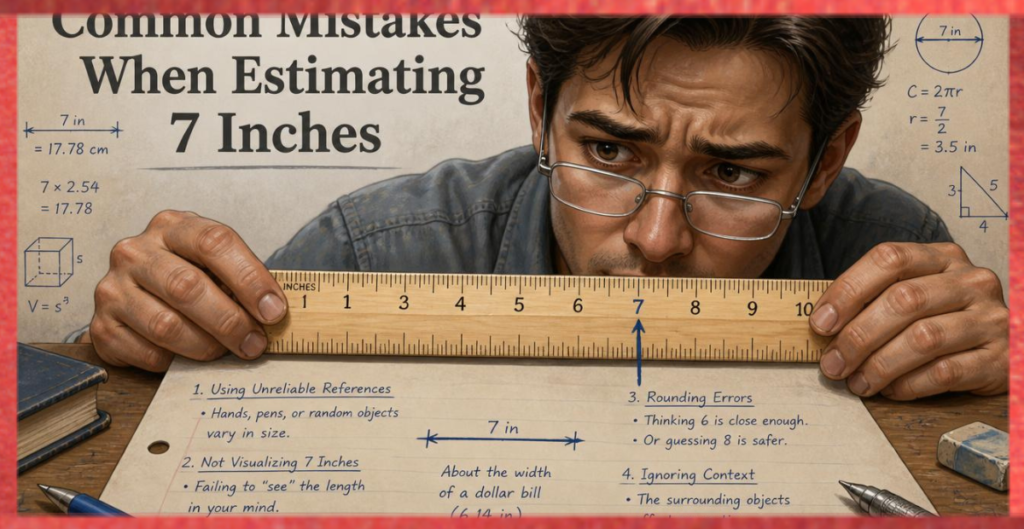
One common mistake is assuming that an object described as “7 inches” must be exactly 7 inches in every dimension. Product descriptions can refer to length, width, height, or even diagonal measurements.
Another mistake is confusing screen size with physical device size. A smartphone with a 7-inch display does not necessarily measure 7 inches from top to bottom.
People also sometimes assume that objects from the same category have standardized dimensions. That’s not always true. Kitchen tools, pencils, fruit, gardening equipment, and technology devices come in many different sizes.
The safest approach is simple: use familiar objects for visual estimation, but confirm important measurements with a ruler or tape.
How to Build a Better Mental Measurement Reference
If you want to get better at estimating length, start with a few reliable reference objects. Choose items whose measurements are relatively consistent and easy to verify.
A ruler is obviously the best starting point. After that, you can learn the approximate size of a few everyday objects and practice comparing other items against them.
Try measuring objects around your home and guessing their length before checking. Write down your estimate, measure the object, and see how close you were.
This little exercise improves mental estimation and makes everyday measurement much less intimidating. After a while, you may look at a box, tool, or piece of wood and immediately think, “That’s probably around 7 inches.” Not bad for something that started as a random number.
Frequently Asked Question
7 inches example
A 7 inches example is a standard pencil, small kitchen utensil, or compact handheld tool, as many can be close to this length.
items that are 7 inches
Common items that are 7 inches long include some pencils, butter knives, small bananas, garden trowels, and compact kitchen tools.
what objects are 7 inches
Objects around 7 inches include certain rulers, pencils, spatulas, handheld tools, and some larger smartphone models.
how big is seven inches
Seven inches is about 17.8 centimeters, roughly the length of a small handheld object or a little more than half of a 12-inch ruler.
7 inch item
A 7 inch item could be a compact spatula, butter knife, pencil, or small gardening tool, depending on its specific design.
Read This Blog https://avenzob.com/20-weeks-from-today/
Final Thoughts on 13 Common Things That Are 7 Inches Long
Seven inches may seem like a small and ordinary measurement, but it appears in plenty of everyday contexts. From kitchen utensils and pencils to gardening tools, craft materials, coins used for comparison, and certain technology devices, there are many ways to make the measurement feel familiar.
The most important thing to remember is that 7 inches equals approximately 17.8 cm. Once you connect that number with real objects, the measurement becomes much easier to visualize.
If you’re searching for examples of 7 inches, use these objects as starting points rather than assuming every item is exactly the same size. A real ruler or measuring tape remains the best choice when accuracy is important.
Ultimately, learning how long is 7 inches isn’t just about memorizing a number. It’s about developing a practical sense of scale.
When you can look at an object and make a reasonable guess about its dimensions, measurements stop being abstract numbers and start becoming something you can actually see, feel, and understand.