There is something oddly charming about watching a die tumble across a table and waiting for it to decide what happens next. A tiny cube can turn a quiet evening into a dramatic victory, a ridiculous challenge, or the beginning of a story nobody planned. That little pause before the result appears is where the fun lives, honestly.
A Non-Conventional Dice Roller takes that familiar idea and stretches it in several directions. Instead of limiting yourself to the ordinary six-sided die,
you can explore different shapes, unusual numbers of faces, symbols, words, colors, and even completely non-numeric dice. For gamers, storytellers, teachers, puzzle lovers, and anyone who enjoys a bit of unpredictable chaos, this opens a surprisingly large playground.
A traditional Dice roller usually produces a number from a familiar range. A more adventurous non-standard dice roller, however, can handle random numbers, unusual outcomes, and creative random events.
You might roll a D20 for a role-playing game, use a D8 for a challenge, or let a custom die decide what happens in a story. It’s simple, but it can get wonderfully weird.
| Topic | Quick Description |
|---|---|
| Non-Conventional Dice Roller | A tool for exploring unusual dice and creative random rolls |
| Unusual Dice | Dice with uncommon numbers, shapes, or symbols |
| Randomness | Produces unpredictable results for games and activities |
| Creative Rolls | Adds variety and fun to traditional dice-based gameplay |
| Polyhedral Dice | Includes D4, D8, D10, D12, D20, and other multi-sided dice |
| Custom Dice | Allows unique sides, numbers, symbols, or outcomes |
| Virtual Dice | Lets users roll different dice digitally without physical dice |
| Game Applications | Useful for tabletop RPGs, board games, challenges, and experiments |
| Probability | Helps explore how different dice shapes affect possible outcomes |
| Experimental Gameplay | Encourages players to create new rules and interesting game mechanics |
What Is a Non Conventional Dice Roller?

A Non-Conventional Dice Roller is a tool or method designed to generate outcomes using dice that don’t necessarily follow the standard six-sided format. It can include polyhedral dice, custom dice, symbolic dice, and other unusual forms of randomness, which makes it useful far beyond ordinary board games.
The key idea is unpredictability. A roller produces an outcome without letting the player simply choose what they want, and that tiny loss of control can be very entertaining.
In practical terms, an online dice roller may simulate different dice while a physical setup lets you throw actual objects onto a table and watch fate do its little dance.
Some rollers are made for random number generation, while others are designed around creative prompts or random events. So, yes, a dice roller can be mathematical, but it can also be playful.
Why Use a Non Conventional Dice Roller?
The appeal isn’t only about getting a random number. A Non-Conventional Dice Roller can make familiar activities feel fresh because it introduces outcomes that players aren’t expecting.
For example, tabletop gamers may use unusual dice to create alternative rules. Writers can use them as story generators. Teachers can introduce probability through hands-on experiments, and friends can use them to settle harmless decisions without the classic “you choose first” argument.
There is also a psychological charm to randomness. When the result isn’t known beforehand, even a small decision can feel important. That’s why dice have survived for centuries in one form or another; people apparently enjoy letting tiny objects make surprisingly serious decisions.
Non-Conventional Dice Roller for Tabletop Games
Tabletop games are probably where unusual dice become most exciting. Games such as Dungeons & Dragons, Backgammon, Boggle, Yahtzee, Monopoly, Risk, and Settlers of Catan all demonstrate how random outcomes can influence play, though they use randomness in different ways.
A role-playing game may require a D20, while another situation could call for a D8 or D12. Some homebrew games go even further by creating custom tables where each result triggers an unexpected event.
A polyhedral dice roller is particularly useful when players don’t own every physical die they need. Instead of searching through a drawer full of tiny plastic shapes, they can simply choose the appropriate die digitally and roll.
And sometimes, the best result isn’t even a useful result. A terrible roll that sends everyone laughing can become the story people remember.
Non Conventional Dice Roller for Creative Decisions

Not every roll needs to belong to a game. A custom dice roller can also work as a decision-making tool.
Imagine a die with outcomes such as “try something new,” “take a break,” “ask someone,” “choose randomly,” or “leave it for tomorrow.” Suddenly, a simple randomizer becomes a tiny personal experiment.
Writers can create dice containing character traits, locations, emotions, plot twists, or actions. One roll might decide where a character goes, another could determine who they meet, and a third could create the problem that ruins their perfectly peaceful afternoon.
That sort of randomness can be useful because creativity doesn’t always arrive when politely invited. Sometimes you need to shake the box a little.
Understanding Different Types of Dice
The world of dice is much larger than the familiar cube. Different types of dice are identified by the number of faces they have, their geometry, or the type of information printed on them.
Here are some common examples:
- Four-sided die (D4): Usually shaped like a tetrahedron, this die produces four possible results.
- Six-sided die (D6): The familiar cube, with six equally likely numbered faces when properly balanced.
- Eight-sided die (D8): An octahedron with eight triangular faces.
- Ten-sided die (D10): Often shaped like a pentagonal trapezohedron and commonly used for percentile rolls.
- Twelve-sided die (D12): A dodecahedron with twelve faces.
- Twenty-sided die (D20): An icosahedron, famous among RPG players and especially associated with D&D.
These shapes aren’t merely decorative. Their geometry determines how many outcomes are available and how the object moves when rolled.
Non-Numeric Dice and Symbolic Outcomes
Numbers aren’t compulsory. Non-numeric dice can contain symbols, colors, letters, images, actions, or words.
A teacher might use symbols for classroom activities. A storyteller could use icons representing locations or emotions. A party game might use a die with instructions such as “swap,” “choose,” “reverse,” or “everyone plays.”
This makes a random dice generator more flexible than a normal number generator because the output can represent an idea rather than a quantity.
In digital form, these dice are particularly easy to customize. You can create a virtual die with almost anything written on its faces, which is handy when imagination has run ahead of the available plastic dice.
Spherical Dice and Other Unusual Shapes

One of the strangest categories includes spherical dice. A sphere doesn’t naturally stop on a numbered face in the same straightforward way that a cube does, so designs have to use internal weights, markings, or other mechanisms to produce readable results.
Unusual polyhedral dice can also include shapes that look almost like tiny mathematical sculptures. The tetrahedron, cube, octahedron, pentagonal trapezohedron, dodecahedron, and icosahedron each create a different visual and physical experience.
A die can therefore be both a gaming object and a miniature lesson in geometry. Not bad for something that usually ends up underneath the sofa.
How Probability Works With Unusual Dice
The mathematics behind dice is where the subject gets genuinely interesting. Probability describes how likely an outcome is, while a probability distribution describes how likely all possible outcomes are.
For a perfectly fair six-sided die, each side has an equal probability of appearing. Each result has a probability of 1/6, or about 16.67%.
For a D20, each face ideally has a 1/20 probability, or 5%, assuming the die is fair.
However, real-world dice aren’t perfect mathematical objects. Small differences in manufacturing, surface finish, material density, or shape can affect dice balance. Usually these differences are tiny, but they are part of what makes physical dice different from theoretical probability models.
Dice Balance, Dice Symmetry, and Fairness
Dice symmetry matters because a symmetrical object is generally better positioned to distribute outcomes evenly. But symmetry alone doesn’t guarantee perfect fairness.
Manufacturing imperfections, rounded corners, uneven numbering, air bubbles, and material density can influence a die. This is why serious players sometimes talk about balanced dice, unbalanced dice, and biased dice.
For casual tabletop games, a small deviation usually isn’t worth losing sleep over. For experiments or professional testing, however, dice testing becomes more important.
A proper dice fairness test might involve rolling a die many thousands of times and examining whether the results appear consistent with the expected distribution. One hundred rolls can be interesting; thousands of rolls tell a much better story.
How Physical Dice Are Tested

There are several informal methods people discuss when investigating physical dice randomness.
The salt water dice test is one popular home experiment. A die is placed in a saltwater solution so that it floats, and then its resting orientation can be observed. The basic idea is to detect whether a die repeatedly settles in a particular orientation.
Another approach is the floating dice test, which is related to examining how a die behaves when buoyancy reduces the effects of gravity on the object.
These methods can reveal potential manufacturing irregularities, but they aren’t perfect scientific guarantees of fairness. A serious assessment would involve controlled testing and statistical analysis rather than trusting one kitchen experiment.
Dice Manufacturing and Mass Produced Dice
Dice manufacturing involves more than simply putting numbers on plastic. Material choice, molding, polishing, engraving, painting, and quality control can all influence the final product.
Mass-produced dice are generally manufactured to consistent specifications, but tiny variations can still happen. Sharp-edged dice, rounded-edge dice, precision dice, and casino-style dice can behave differently.
The way numbers are arranged can matter too. Some manufacturers use arrangements intended to distribute opposite-face totals consistently, while others may use different numbering patterns.
For ordinary gaming, these differences are mostly part of the personality of the dice. For serious statistical work, though, manufacturing details become much more important.
Virtual Dice Roller vs. Physical Dice
A virtual dice roller offers convenience. You don’t need to carry a bag of RPG dice, and you can instantly switch from a D6 to a D20 or another die.
Digital systems commonly rely on a pseudo-random number generator. An algorithm produces sequences that appear random according to mathematical rules. This is different from true randomness, which usually involves some unpredictable physical process.
That doesn’t mean virtual dice are “bad.” For most games, a properly designed random number system works perfectly well.
Physical dice, meanwhile, introduce real-world movement, friction, imperfections, and environmental variables. Their randomness comes from a messy physical process, which is part of their charm.
What Makes Random Dice Results Useful?

The value of random dice results depends on what you’re using them for.
In gaming, randomness prevents players from knowing exactly what will happen. In education, it demonstrates probability. In creative writing, it can generate ideas. In decision-making, it can break a tie.
A dice randomizer is especially useful when the available choices are discrete and reasonably equal. If you have six lunch options and genuinely don’t care which one you eat, a D6 can settle the matter without a 20-minute debate.
For more complicated decisions, though, be careful. A random tool doesn’t magically make every option equally suitable. Randomness is a method, not wisdom.
Non-Conventional Dice Roller for RPGs
Role-playing games are practically built for unusual dice. A typical RPG dice set may include a D4, D6, D8, D10, D12, and D20, with different dice used for different mechanics.
In Dungeons & Dragons, for example, the D20 is central to many checks, attacks, and saving throws. Other dice determine damage, healing, or other values.
A D&D dice roller can be useful for players who want quick digital rolls, especially during online sessions. It also helps new players learn what each die looks like without immediately buying a whole collection.
The fun part is that one roll can completely change the mood around the table. A natural 20 can create cheers. A disastrous result can create a silence so dramatic you’d think somebody had announced bad news.
Non-Conventional Dice Roller for Random Events
A random events generator can turn a basic dice roll into an entire event system.
Suppose you’re creating a fantasy adventure. A D6 might determine the weather, while a D8 chooses an encounter and a D20 determines its difficulty. Suddenly, three tiny rolls can create a scene nobody planned.
You can use the same concept for writing prompts, classroom exercises, party games, worldbuilding, or improvisation.
A tabletop randomizer doesn’t need complicated rules. Even a small table of outcomes can produce surprisingly different combinations when repeated.
Using Dice for Probability Experiments
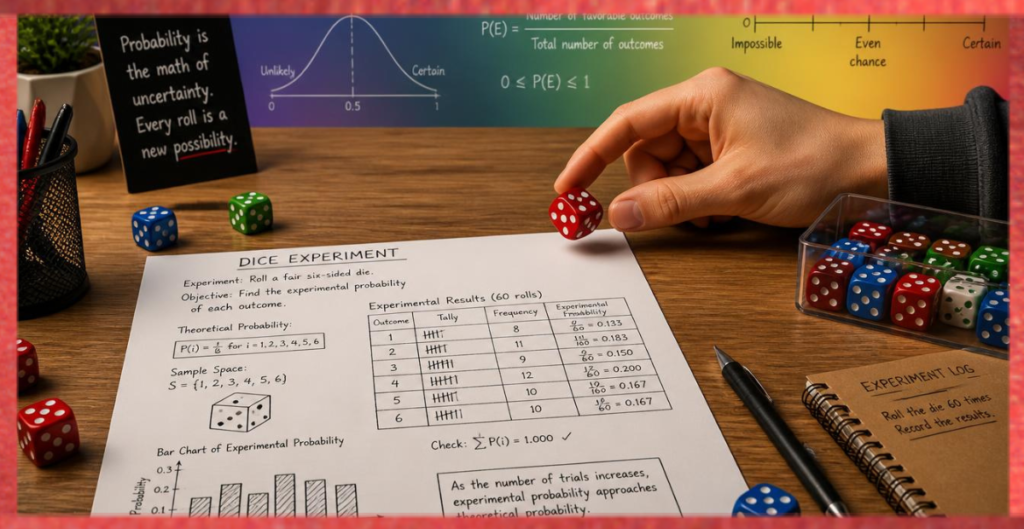
Dice are excellent educational tools because probability becomes something you can actually see.
Roll a D6 ten times and record the results. Then roll it 100 times. The first experiment may look wildly uneven, while the larger sample often begins moving closer to the expected probability distribution.
This demonstrates an important idea: randomness does not mean every small sample will look perfectly balanced.
If you roll a six-sided die six times, you shouldn’t expect one of each number. That would be possible, but it isn’t required. Dice roll probability describes the likelihood of outcomes, not a promise about what must happen.
ll
This question gets surprisingly philosophical. A physical die can produce unpredictable results because its movement depends on many physical variables, including force, angle, surface interaction, air movement, and microscopic imperfections.
Digital dice usually use algorithms. A pseudo-random number generator can produce sequences that look random while actually following a deterministic process.
Some specialized systems use physical sources of entropy to create random values, which can get closer to true randomness.
For ordinary games, however, you usually don’t need to worry about philosophical arguments between randomness and determinism. If everyone at the table accepts the result, the die has done its job.
Non-Conventional Dice Roller Beyond Gambling
Dice are sometimes associated with gambling, but their uses are much broader.Board games, educational activities, storytelling, role-playing games, probability demonstrations, creative exercises, and casual decision-making can all use dice without involving money or wagering.
This distinction is worth remembering because randomness itself isn’t gambling. A random event can simply be a fun mechanism for choosing what happens next.
A child rolling a D6 to decide which color to draw is using randomness. Friends rolling a die to select a movie are using randomness. Players wagering money based on dice outcomes introduces a different context.The object is the same; the activity around it changes.
How to Create Your Own Unusual Dice System
Creating a personal dice system is easier than it sounds.
Start by deciding what kind of outcomes you need. If you have six possibilities, a D6 may be enough. If you need twenty possibilities, a D20 gives you a neat structure.
For something more creative, replace numbers with words or symbols. You could build a die for emotions, another for locations, and another for actions.
For example, a story generator might have:
- A location die containing forest, city, island, castle, village, and desert.
- An action die containing chase, discover, escape, negotiate, hide, and investigate.
- An emotion die containing joy, fear, curiosity, anger, confusion, and relief.
Three rolls later, you’ve got the skeleton of a story. It’s not Shakespeare, maybe, but it gets the engine running.
Tips for Choosing a Non-Conventional Dice Roller

When selecting an online random dice generator, think about what you actually need instead of choosing the fanciest-looking tool.
Look for a roller that:
- Supports multiple dice types.
- Clearly displays each dice result.
- Lets you roll several dice together.
- Offers custom or symbolic outcomes when needed.
- Provides transparent randomization where appropriate.
- Works smoothly on phones and computers.
- Doesn’t bury the actual roll beneath unnecessary features.
If you’re playing an RPG, a polyhedral dice roller is probably more useful than a simple six-number generator. If you’re creating writing prompts, customizable outcomes matter more.
The best tool is the one that gets out of the way and lets randomness do its little job.
Creative Ways to Use a Non-Conventional Dice Roller
The possibilities are much wider than gaming.
You could use unusual dice for:
- Storytelling prompts.
- Classroom probability activities.
- Character creation.
- Fantasy worldbuilding.
- Choosing random challenges.
- Selecting art subjects.
- Improvisation exercises.
- Party games.
- Workout variations.
- Daily creativity prompts.
A random number generator can make decisions numerical, but a custom die can make them meaningful. That’s the real advantage of unconventional dice: you can design randomness around the activity rather than forcing the activity into a standard six-sided box.
Frequently Asked Question
dice roller
A dice roller is a simple tool that randomly generates a number, usually from 1 to 6, like rolling a standard die.
google dice roller
Google dice roller is an online tool that lets you roll a virtual die directly in your browser without needing a physical die.
roll dice
Roll dice means generating a random result from one or more dice. It is useful for games, decisions, and quick random selections.
online dice roller
An online dice roller lets you roll virtual dice on your phone or computer. You can use it anytime without carrying physical dice.
roll a die
To roll a die means to generate one random number from 1 through 6 on a standard six-sided die.
Read this blog https://avenzob.com/what-time-was-it-7-hours-ago-find-out-instantly/
Final Thoughts on the Non-Conventional Dice Roller
A Non-Conventional Dice Roller is really a celebration of uncertainty dressed up as a tool. Sometimes it gives you a number. Sometimes it gives you a symbol, a challenge, a story direction, or a result you absolutely did not want but secretly needed.
From the humble cube to elaborate polyhedral dice, from physical tabletop gaming to a digital online dice roller, dice continue to occupy that lovely space between mathematics and play. Their faces are predictable, yet the moment they tumble, the outcome becomes unknown.And perhaps that’s why they remain so satisfying.
A good die doesn’t promise that you’ll win. It simply promises that the next moment hasn’t been decided yet.
Whether you’re using d4 dice, d6 dice, d8 dice, d10 dice, d12 dice, d20 dice, symbolic dice, or an entirely homemade system, the best approach is to enjoy the uncertainty. Test your dice when fairness matters, understand dice probability when you’re studying outcomes, and embrace a little chaos when you’re simply playing.
If you have a favorite unusual die, a strange tabletop rule, or a memorable roll that changed an entire game, share the story. Sometimes the most entertaining part of randomness isn’t the number that appears it’s what everybody does after seeing it.