There are some holidays that seem to arrive with a ready-made vocabulary of their own, and Valentine’s Day is one of those lovely, slightly confusing examples.
In one place it may be called Saint Valentine’s Day, somewhere else Dia de São Valentim, and in another culture people may connect the same idea with a completely different festival, season, or old story.
The name changes, but the little human wish underneath it stays rather stubbornly familiar: I care about you.That is what makes exploring the Other Names and Languages of this celebration so interesting.
A holiday can travel across borders without packing a suitcase, picking up new names, customs, foods, flowers, legends, and even different dates along the way.
February 14 is widely recognised as the date of this romantic holiday, yet the worldwide celebration of affection is much bigger than one calendar square.
From Saint Valentine of Rome and Saint Valentine of Terni to modern greeting cards, chocolates and carefully planned date nights, the story has collected many layers.
Some are historical, some legendary, some religious, and some were added by clever merchants who clearly knew that people have a soft spot for heart-shaped chocolate. A bit of all of it makes the modern celebration what it is today.
| Language | Name for Valentine’s Day |
|---|---|
| English | Valentine’s Day |
| Spanish | Día de San Valentín |
| French | Saint-Valentin |
| German | Valentinstag |
| Italian | San Valentino |
| Portuguese | Dia dos Namorados |
| Dutch | Valentijnsdag |
| Arabic | عيد الحب |
| Hindi | वैलेंटाइन डे |
| Urdu | ویلنٹائن ڈے |
| Chinese | 情人节 |
| Japanese | バレンタインデー |
| Korean | 발렌타인데이 |
| Russian | День святого Валентина |
| Turkish | Sevgililer Günü |
Why Is It Called Valentine’s Day?
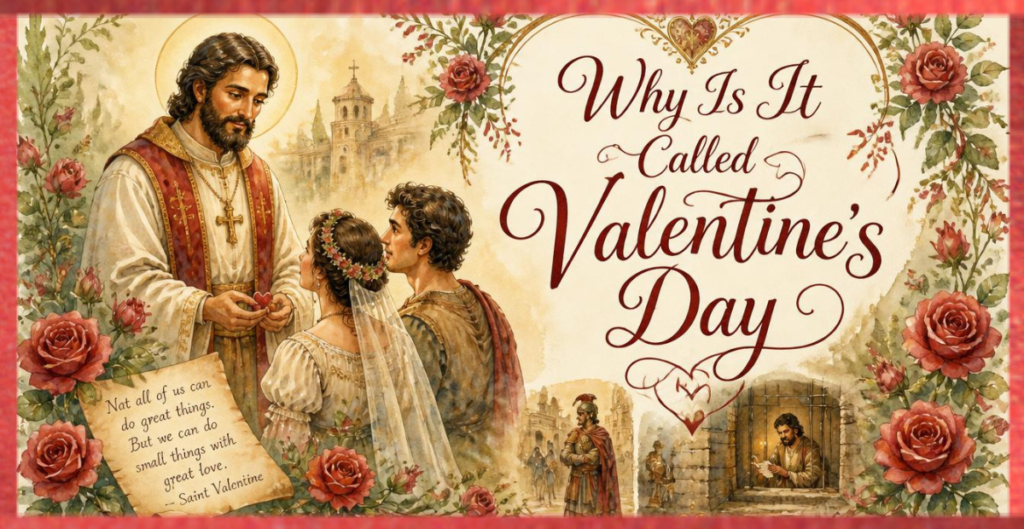
The most familiar name, Valentine’s Day, comes from Saint Valentine, a Christian martyr traditionally associated with love and affection.
Historical evidence about the saint is limited and tangled with later legends, so it is wiser to speak of traditions and stories rather than pretending every romantic tale is a confirmed fact.
The name Saint Valentine’s Day points more directly toward its religious background. In the Roman Catholic Church, February 14 was associated with the feast of Saint Valentine, while different Christian calendars and traditions have changed how saints and feast days are observed over time.
You may also encounter the phrase Feast of Saint Valentine or Saint Valentine feast day. These names sound rather formal beside a box of chocolates, but they remind us that the holiday did not begin as a modern shopping event.
It had religious associations long before department stores discovered red ribbons.The expression Day of Love is much more modern and informal.
It describes what many people think the celebration means today: a dedicated moment for affection, romance, friendship and appreciation. It can include lovers, married couples, family members, friends, children and even co-workers, depending on the culture.
In Spanish-speaking communities, related celebrations may use names such as Día del Amor y Amistad, meaning “Day of Love and Friendship.”
In Brazil, the familiar name is Dia de São Valentim, although the country traditionally celebrates romantic affection on June 12, rather than February 14.
Other Names and Languages Around the World
Language has a funny habit of changing a celebration without really changing its heart. The name might become longer, shorter, sweeter or almost impossible for a visitor to pronounce on the first attempt, but the basic idea still manages to survive.
Here are some widely recognised names and related expressions:
- Valentine’s Day English-speaking countries and many international settings.
- Saint Valentine’s Day a fuller English name emphasizing the saintly tradition.
- Dia de São Valentim Portuguese, especially associated with Brazil.
- Día de San Valentín Spanish for Saint Valentine’s Day.
- Día del Amor y Amistad “Day of Love and Friendship,” used especially in parts of Latin America.
- La Semana de la Dulzura “Week of Sweetness,” an Argentine celebration connected with exchanging sweets.
- Saint Dwynwen’s Day a Welsh love celebration observed on January 25.
- Qixi Festival a traditional Chinese festival often described internationally as the Chinese Day of Love.
- Double Seventh Festival another English name for Qixi, referring to its traditional lunar-calendar date.
- Tu B’Av a Jewish festival associated with love and matchmaking.
- White Day March 14, especially associated with Japan, South Korea and some other East Asian countries.
- Black Day April 14 in South Korea, traditionally associated with people who did not receive romantic gifts on earlier days.
- Día del Amor y Amistad a name that broadens romance into friendship and affection.
These names are not all exact linguistic translations of Valentine’s Day, and that distinction matters. Some describe completely separate festivals that happen to serve a similar emotional purpose. Culture rarely copies a holiday perfectly; it tends to remix it a little.
Valentine’s Day in Different Languages
The phrase can sound surprisingly different from one language to another, which is part of the charm of international celebrations.
In Italian, the language of Rome and the country where several Saint Valentine traditions developed, the day is commonly called San Valentino.
In French, it is la Saint-Valentin. German uses Valentinstag, while Portuguese uses Dia dos Namorados in Brazil, literally referring to a day connected with sweethearts or lovers.
Spanish speakers commonly use Día de San Valentín or simply San Valentín. In many countries, though, local expressions may give the celebration a more community-oriented meaning. That is why love and friendship can appear together rather naturally.
In Welsh tradition, Dydd Santes Dwynwen or Saint Dwynwen’s Day gives Wales its own distinctive love festival. It is celebrated on January 25, creating an interesting example of how a culture can have a local patron saint and a separate date for romantic affection.
Language also changes the mood of a message. “Happy Valentine’s Day” feels familiar and universal, while a greeting using a local name can feel more intimate.
Sometimes one translated phrase is enough to make a card seem as though it travelled a thousand miles just to reach one person.
Saint Valentine, Legends, and the Ancient World
The history behind the holiday is not a neat little road from ancient Rome to a modern chocolate shop. It is more like a drawer full of old letters, some authentic, some copied, and some where nobody is quite sure who wrote them.
Several saints named Valentine or Valentinus appear in early Christian history. Saint Valentine of Rome and Saint Valentine of Terni are particularly important in later traditions.
Stories about the saint include imprisonment, Christian faith, helping couples, and a famous association with a love letter.
One popular legend says that Valentine helped Christian couples marry despite restrictions associated with Roman Emperor Claudius II.
The story is charming, but historians have not established it as firm fact. This is one reason responsible discussions of Saint Valentine history should distinguish documented evidence from later folklore.
Another tradition connects Valentine with a young woman who visited him while he was imprisoned. A supposed farewell message ending with an expression such as “your Valentine” became part of the romantic mythology. It is a beautiful story, though its historical reliability remains uncertain.
The saint was reportedly executed, and his association with February 14 became part of Christian tradition. Pope Gelasius I is often mentioned in discussions about the fifth-century establishment of a feast connected with Saint Valentine, although the exact relationship between the feast and later romantic customs is more complicated than many popular summaries suggest.
Lupercalia and Valentine’s Day: Are They the Same?

One of the most repeated claims about Valentine’s Day origins is that the holiday simply replaced Lupercalia, an ancient Roman festival. The reality is much less tidy.
Lupercalia was a Roman festival associated with fertility, purification and the legendary founders of Rome. It was connected with Lupercus in later interpretations and took place in February. Because the timing overlaps with later Valentine traditions, people often connect the two.
However, historians do not have solid evidence proving that Valentine’s Day was directly created as a Christian replacement for Lupercalia. Saying “Valentine’s Day is simply Lupercalia renamed” makes a complicated history sound much cleaner than it actually was.
The broader transition from the Roman Empire to Christianity did influence many calendars and cultural practices, of course. Yet traditions often evolve through several generations instead of changing overnight. History, inconveniently, refuses to behave like a tidy infographic.
Geoffrey Chaucer and the Romantic Valentine
The connection between February 14 and romantic love became stronger during the Middle Ages. One especially important figure is English poet Geoffrey Chaucer.
In Parliament of Fowls, Chaucer connected Saint Valentine’s feast day with birds choosing their mates. This literary association helped strengthen the idea of February 14 as a day connected with romantic relationships.
Later medieval writers continued playing with the idea of love, birds, courtship and written affection. Charles Duke of Orleans is often associated with one of the earliest surviving Valentine letters, written while he was imprisoned in the Tower of London.
That connection between poetry and personal correspondence matters enormously. Before texting, before emojis, before sending a heart reaction without thinking about it, people used love letters, poems and carefully decorated cards. A single sentence could take days to travel, so people had to make the sentence count.
Valentine’s Day During the Victorian Era
By the Victorian era, Valentine’s Day had become increasingly associated with printed cards, romantic symbolism and elaborate decoration. The 1800s saw the growth of commercial card production, making romantic greetings easier for ordinary people to exchange.
Richard Cadbury and the Cadbury company are often mentioned in the development of beautifully packaged chocolates associated with romance.
Chocolate boxes became a clever combination of sweetness and presentation, and honestly, that pairing has survived remarkably well.
Victorian cards could feature ribbons, satin, lace, flowers, birds and decorative hearts. Some were tender, some humorous, and some were deliberately insulting.
Not every Valentine was a declaration of eternal devotion; a few were apparently designed to deliver a tiny emotional slap through the post.
The growth of cards and sweets helped transform Valentine’s Day into a commercial holiday, but commerce did not erase the emotional side. Instead, it gave people more physical objects through which to express affection.
Valentine’s Day Symbols and Gifts
Modern Valentine’s Day symbols are almost a language by themselves. A red rose can say romance without a single written word, while a small box of chocolates may communicate affection in a way that is deliciously difficult to misunderstand.
Common symbols and gifts include:
- Valentine’s Day cards with personal messages.
- Greeting cards decorated with hearts and flowers.
- Love letters for a more intimate expression.
- Love poems for people who enjoy a little dramatic language.
- Red roses, traditionally linked with romantic love.
- Chocolates and chocolate boxes for a classic sweet gesture.
- Heart-shaped chocolates for an unmistakably Valentine-themed gift.
- Cupid and cherubs in decorative artwork.
- Love birds representing affection and partnership.
- Gifts ranging from handmade crafts to jewellery.
- Sweets exchanged between friends and loved ones.
- A planned date night for couples wanting time together rather than another object.
The nicest gift, however, is rarely the most expensive one. A handwritten note saying exactly why you appreciate somebody can beat a giant shopping bag, and it doesn’t need batteries either.
Valentine’s Day Traditions Around the World

The phrase Valentine’s Day around the world covers a wonderfully messy collection of traditions. Different countries have developed their own versions, while some have adopted February 14 relatively recently.
In South Korea, romantic celebrations extend across several monthly occasions, including White Day on March 14 and Black Day on April 14. The result is a whole little calendar of romance, gifting and playful social customs.
In China, the Qixi Festival, also called the Double Seventh Festival, traditionally falls on the 7th day of the 7th Chinese lunar month. Its central love story concerns Niulang and Zhinü, two figures separated by the Milky Way and allowed to meet once a year.
In Israel, Tu B’Av, associated with the 15th of Av, is sometimes described as a Jewish festival of love. Its traditions have historical roots distinct from the Christian Valentine’s Day tradition.
In Wales, Saint Dwynwen’s Day is celebrated on January 25. Saint Dwynwen is remembered as a Welsh patron saint associated with lovers, making the occasion an important local example of a love festival.
In Argentina, La Semana de la Dulzura, or Week of Sweetness, traditionally involves exchanging sweets. In Colombia, Día del Amor y Amistad places noticeable emphasis on both love and friendship, showing that affection does not always need to wear romantic shoes.
Valentine’s Day in India, Brazil, and Other Countries
Valentine’s Day in India has become especially visible among young people, with couples and friends exchanging cards, flowers, chocolates and gifts.
The celebration exists alongside India’s many local festivals and cultural traditions, so the way it is observed can vary greatly between families and communities.
In Brazil, the major romantic date is traditionally June 12, known as Dia dos Namorados. It falls immediately before Saint Anthony’s Day, and Saint Anthony has a strong association with marriage and matchmaking in Brazilian popular tradition.
The date therefore occupies a role similar to Valentine’s Day in many other countries.Valentine’s Day in Colombia is often connected with September celebrations of love and friendship rather than February 14.
Uruguay, Bolivia, and other countries also have local customs or alternative dates, demonstrating that the global language of love does not require everyone to circle the same day.
In some regions, romantic celebrations are closely tied to marriage, while elsewhere they may focus more heavily on friendship, family or school activities.
Children may exchange simple cards, friends may share sweets, and co-workers may participate in lighthearted office traditions. Romance is only one chapter of the larger story.
Valentine’s Day Week and Its Popular Names
In some places, especially through modern social-media culture, Valentine’s Day has expanded into a sequence commonly called Valentine’s Day Week.
The popular sequence may include:
- Rose Day on February 7, associated with giving roses.
- Propose Day on February 8, connected with declarations and proposals.
- Chocolate Day on February 9, unsurprisingly devoted to chocolates.
- Teddy Day on February 10, often involving soft toys.
- Promise Day on February 11, focused on commitments.
- Hug Day on February 12, centred on affection.
- Kiss Day on February 13, leading into February 14.
These names are largely modern popular culture rather than ancient religious traditions. Still, people enjoy them because they turn one celebration into several small moments. A whole week gives romance a little more breathing room, which is not such a bad idea.
When February 14 Is Not the Main Date
One fascinating part of alternative Valentine’s Day dates is that love celebrations can appear throughout the calendar.
Saint Dwynwen’s Day falls on January 25 in Wales. Tu B’Av occurs according to the Jewish calendar, while Qixi follows the Chinese lunar calendar. Brazil traditionally celebrates Dia dos Namorados on June 12.
Argentina’s Week of Sweetness takes place in July, and other regional celebrations have their own dates. Some countries also adapt the celebration according to seasons; February occurs during winter in the Northern Hemisphere but during summer in the Southern Hemisphere.
So when someone asks, “Why is Valentine’s Day February 14?” the answer depends on whether they mean the Christian feast, the modern romantic holiday, or the many international festivals that now occupy a similar cultural space. There is no single universal calendar for love.
Religious Names and Christian Traditions

The religious history of Valentine’s Day is equally layered. The day is connected historically with Christianity, the Roman Catholic Church, and different Christian denominations, although modern celebrations are usually secular.
Some traditions have included Saint Valentine among saints associated with lovers or young people. Historical sources and later traditions have also connected Valentine with conditions such as epilepsy, sometimes described historically using expressions such as “falling disease” or Valentine’s Malady.
These associations are part of saintly folklore and patronage traditions rather than modern medical explanations. It is important not to confuse historical religious beliefs with contemporary medical knowledge.
Different churches have also changed or revised their calendars. The Catholic calendar, traditional Catholic calendar, Anglican Communion, Lutheran Churches, and Eastern Orthodox traditions do not necessarily treat Saint Valentine in precisely the same way.
This is a useful reminder that a name appearing in one calendar does not automatically mean the entire Christian world celebrates it identically. Religious traditions, like languages, have branches.
How Valentine’s Day Became a Worldwide Celebration
Modern Valentine’s Day spread through a mixture of literature, migration, printed cards, commerce, advertising and popular culture. During the 1800s, mass-produced cards made romantic greetings more accessible, while chocolates and flowers became increasingly recognizable symbols.
The twentieth century expanded the holiday further. By 1948, for example, Valentine’s Day traditions were already established in many communities outside their original European settings, and by 1969, changes to the Roman Catholic calendar reflected broader decisions about which saints received universal liturgical recognition.
Later, television, cinema, advertising and the internet made the holiday almost instantly recognizable across borders. A red heart became a visual shortcut for affection. A box of chocolates became a predictable but comforting gesture. A rose became an entire sentence without grammar.
This is why Valentine’s Day commercialization is both criticised and unavoidable. Marketing campaigns can make the holiday feel like an obligation, but people can also reclaim it as a small personal ritual. The meaning is often decided by the people exchanging the card, not the company printing it.
How to Use Different Names in Your Greetings
Using a local name can make a Valentine message feel thoughtful, especially when you are writing to someone from another country or culture.
For example, a simple greeting could mention San Valentino for an Italian friend, la Saint-Valentin for a French-speaking recipient, or Día del Amor y Amistad when acknowledging the love-and-friendship tradition found in parts of Latin America.
You do not need to become a language expert overnight. Even one correctly used phrase, followed by a heartfelt personal sentence, can make a greeting feel less copied and much more human.
Try adding a memory, an inside joke, or a specific quality you admire. “Happy Valentine’s Day” is perfectly fine, but “Happy Valentine’s Day to the person who somehow makes grocery shopping feel like an adventure” sounds like it belongs to two actual people, which is the whole point.
How to Make Valentine’s Day More Personal

The best Valentine’s Day traditions are not necessarily the oldest ones. Sometimes a tradition becomes meaningful because two people repeat it every year until it quietly becomes “their thing.”
You might exchange handwritten love letters, cook the same meal every February, visit the place where you first met, watch an old favourite movie, or take a simple evening walk. Couples can plan a Valentine’s Day date night, while friends can exchange chocolates or handwritten appreciation notes.
Families can include children too. A child may not understand romantic love, but they certainly understand being appreciated. A small handmade card for a parent, grandparent or sibling can turn February 14 into a broader celebration of affection.
And if romance is not your thing this year, that is completely okay. Spend the day with friends, call family, help someone who needs kindness, or simply enjoy your own company. The Day of Love does not have to become a performance.
Frequently Asked Question
valentine’s day
Valentine’s Day is celebrated every year on February 14 as a special occasion to express love, affection, and appreciation.
valentine day
Valentine Day is another common way of referring to February 14, when people celebrate romantic relationships and meaningful connections.
वेलेंटाइन डे लिस्ट
A Valentine’s Day list may include gifts, flowers, chocolates, greeting cards, date ideas, and other ways to celebrate love.
aaj kaun sa de hai
If you mean “which day is today,” the answer depends on the current date and the occasion being observed today.
today valentine’s day
Today is Valentine’s Day only when the current date is February 14; it is celebrated annually on that date.
Read This Blog https://avenzob.com/10-weeks-from-today/
Final Thoughts on Other Names and Languages
Exploring Other Names and Languages connected with Valentine’s Day reveals something rather beautiful: love is remarkably good at surviving translation.
It can be called Saint Valentine’s Day, San Valentino, Día de San Valentín, Dia de São Valentim, Día del Amor y Amistad, or connected with festivals such as Qixi Festival, Tu B’Av, and Saint Dwynwen’s Day. The dates and customs may shift, yet people still find ways to say, “You matter to me.”
The history is not perfectly simple. There are saints and legends, ancient Rome, medieval poetry, religious calendars, Victorian cards, chocolate boxes, commercial campaigns and modern social media.
Some stories are well documented; others have become folklore through centuries of retelling. That mixture is part of what makes the celebration so interesting.
So, whether your Valentine greeting arrives on February 14, January 25, June 12, a lunar-calendar date, or another culturally meaningful day, the most valuable part is rarely the date itself. It is the intention behind the message.
Write something only you could have written. Say the thing you normally assume the other person already knows. Give a flower, a card, a chocolate, a poem, or just five honest minutes of attention. Sometimes the smallest gesture carries the biggest language of all and thankfully, nobody needs a dictionary for that.