There is something wonderfully simple about a Pizza arriving at a crowded table. A box opens, everyone suddenly gets a little quieter, and somehow the first slice becomes the beginning of the whole evening.
Whether you’re planning a Birthday Party, a family celebration, a Big Game, or just a casual Gathering, pizza has a funny way of making people feel welcome. And yes, even the most carefully planned party can go sideways when nobody knows how many pizzas to order.
That is exactly where a Pizza Calculator becomes useful. Instead of guessing, counting hungry faces, or buying an awkward mountain of leftovers, you can estimate the Pizzas Needed based on your Guests, their appetite, and the size of the pizza. It turns a slightly annoying question “how many pizzas do I need?” into something much easier.
| Number of People | Large Pizzas Needed |
|---|---|
| 5 | 2 pizzas |
| 10 | 4 pizzas |
| 15 | 6 pizzas |
| 20 | 8 pizzas |
| 25 | 10 pizzas |
| 30 | 12 pizzas |
| 40 | 15 pizzas |
| 50 | 19 pizzas |
What Is a Pizza Calculator?
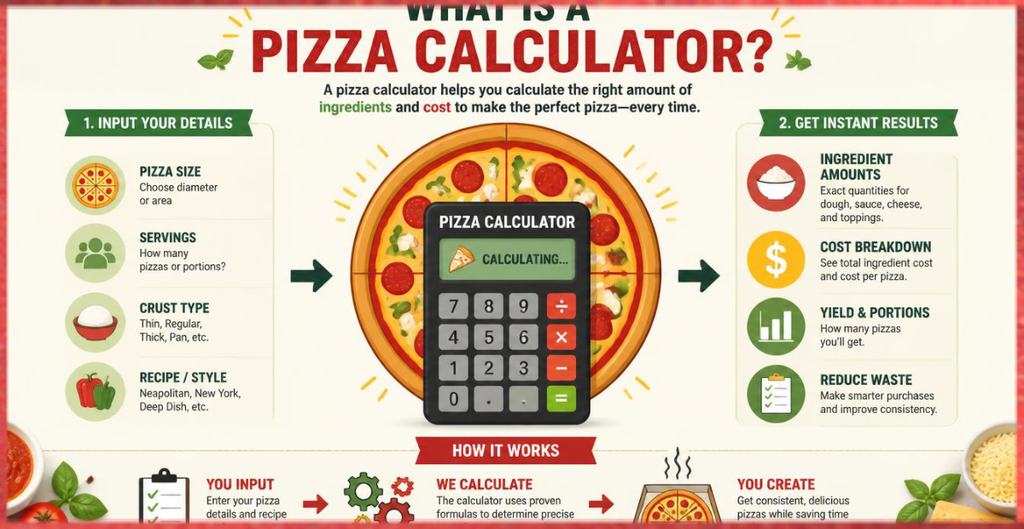
A Pizza Calculator is a simple planning tool that estimates the Number of Pizzas required for a particular group. It generally considers the Number of Guests, the number of Adults, the number of Children, the Hunger Level, and sometimes the Crust Type or pizza size. Sounds tiny, but these details can make a surprisingly big difference.
For example, four hungry adults eating dinner will usually need more food than four children having small slices alongside snacks. Likewise, a Large 14-inch Pizza can provide considerably more food than a Small Pizza, so simply saying “one pizza feeds four people” can be a bit too rough.
A good pizza serving calculator gives you a starting point rather than pretending every person eats exactly the same amount. Some guests take one slice and wander away happily, while others inspect the box like they have been training for this moment all year.
How the Pizza Calculator Estimates Pizzas Needed
The basic idea behind most pizza quantity calculators is fairly straightforward. First, estimate how many Pizza Slices your guests are likely to eat. Then compare that number with the expected slices available from each pizza.
A common planning estimate is 3 slices per adult and 2 slices per child. If a standard pizza provides around 8–10 slices per pizza, you can divide the total expected slices by the number of slices in one pizza. This is not a law of pizza, thankfully, but it is a practical starting point.
A simple Pizza Formula can be written as:
p = 3a/8
Here, p represents the approximate number of pizzas and a represents the number of adults when using three slices per adult and eight slices per pizza.
For groups containing children, the calculation can be adjusted by adding roughly 2 slices per child before dividing by the expected slices per pizza.
For example, ten adults at three slices each would need about 30 slices. If each pizza has eight slices, 30 divided by 8 gives 3.75, so rounding upward means about four pizzas. A little extra is generally wiser than discovering the final slice has become a diplomatic crisis.
Pizza Calculator for Adults and Children
When planning a Pizza Order, separating Adults and Children can make the estimate more realistic. Adults often eat more than younger children, although there is always that one kid who somehow finishes two slices before everyone else has even opened their drink.
For a simple estimate, use three slices per adult and two slices per child. Then divide the combined slices by the expected slices in each pizza. If your pizzas are unusually large or small, adjust the calculation instead of blindly following the numbers.
Suppose you have 12 adults and 6 children. The adults might need 36 slices, while the children might need 12 slices. That gives you an estimated 48 slices altogether. If your pizza provides eight slices, you would need approximately six pizzas.
This approach is especially handy when you’re ordering pizza for a group, because it takes the actual mix of people into account instead of treating every guest as identical. Real parties, thankfully, are not spreadsheets.
Pizza Calculator by Hunger Level

The Hunger Level can completely change the Number of Pizzas Needed. A lunch meeting with light snacks is different from a Friday night gathering where everyone skipped dinner, and pretending otherwise is how empty pizza boxes appear much too early.
A light appetite may work with the basic serving estimate. A normal appetite can use the standard pizza servings per person calculation, while a very hungry group may need an additional pizza or two depending on group size.
For a Pizza for a Crowd, it can help to think about the entire meal. If pizza is the main dish and there are few other foods, use a more generous estimate. If you’re serving breadsticks and salad, Drinks, appetizers, and Desserts, guests may eat fewer slices.
The safest approach is to use the calculator as your baseline and then consider the situation. Hungry guests are not a rounding error, they are hungry guests.
Pizza Calculator by Pizza Size
Pizza size matters more than many people realize. A Small Pizza, Medium Pizza, Large Pizza, and Extra-Large Pizza do not simply differ by a few inches—the available surface area changes as the diameter increases.
A small pizza may work nicely for an individual meal, while a large pizza is usually more practical when you’re feeding several people. An Extra-Large Pizza can be particularly useful for bigger gatherings because fewer boxes may be required.
A basic pizza size guide might look like this:
- Small Pizza: Usually suited to one person or a light meal.
- Medium Pizza: Useful for a couple of people or a smaller appetite.
- Large Pizza: A popular choice for family meals and parties.
- Extra-Large Pizza: Helpful when feeding a crowd or placing a large-volume order.
The exact number of slices depends on the pizzeria, though, so check the restaurant’s serving information before making the final Pizza Order. One restaurant’s “large” can feel like another restaurant’s medium, which is mildly confusing but very real.
Traditional Crust vs. Thin Crust
The Crust Type also deserves attention. A Traditional Crust or Classic Crust is usually thicker and more filling than a Thin Crust, while Deep Dish can be particularly substantial. So two pizzas with the same diameter may not leave guests equally satisfied.
A Thin Crust pizza may encourage people to eat more slices because each slice contains less crust and can feel lighter. With a thicker crust, guests might become full sooner. It doesn’t happen perfectly every time, but it is worth considering.
If you’re serving several pizza styles, you can mix them. A group might enjoy a Meat Pizza, a vegetarian option, a Gluten-Free Pizza, and a Dairy-Free Pizza so guests with different preferences have something they can actually eat.
The goal isn’t to calculate every crumb. It’s simply to avoid ordering six huge deep-dish pizzas for a group that expected light, crispy slices.
How Many Pizzas for a Party?

The question “how many pizzas for a party” sounds simple until you have twenty people staring at you. A Pizza Party Calculator can make the planning easier by starting with guests, appetite, and serving size.
For a small Party, begin with the number of people and estimate slices. For a larger Group, it can be helpful to round upward, particularly if pizza is the primary meal. Nobody complains much about an extra slice being available later.
For a Birthday Party, consider the other foods too. Cake, snacks, fruit, drinks, and desserts can reduce the amount of pizza guests eat. On the other hand, a late-evening party where pizza is the only substantial food calls for a more generous estimate.
A little context goes a long way here. The calculator gives you numbers, but you provide the common sense.
How Many Pizzas for 10, 20, 30, or 50 People?
Planning for different group sizes becomes easier when you use a consistent serving assumption. If you’re wondering about pizzas for 10 people, pizzas for 20 people, pizzas for 30 people, or pizzas for 50 people, start with the expected slices rather than immediately picking a number of boxes.
For example, using three slices per adult and eight slices per pizza, ten adults would need approximately four pizzas. Twenty adults would need around eight pizzas, while thirty adults would need around twelve pizzas. Fifty adults could require roughly nineteen pizzas after rounding upward.
These figures are estimates, not sacred pizza mathematics. If children make up part of the group, use fewer slices per child. If the gathering includes plenty of pizza and sides, the final order may be smaller.
For large groups, ordering a few extra pizzas can also make sense because coordinating food for fifty people is not the moment to practice extreme minimalism.
Pizza for Lunch vs. Pizza for Dinner
The meal itself can affect your estimate. Pizza for lunch may require fewer slices if guests are also eating salads, sandwiches, fruit, or other foods. Pizza for dinner, especially when pizza is the main course, often calls for a larger portion.
A lunch meeting might use a moderate pizza serving size, while a dinner party with hungry adults may need a more generous serving estimate. If you’re planning a Family Picnic, there may be several other foods available, which changes the calculation again.
For a Game Night, however, pizza often disappears surprisingly quickly. People may take one slice between rounds, then another, then suddenly somebody announces that the final slice is “reserved.” This is why a little extra food can be useful.
Pizza Calculator for Special Dietary Needs
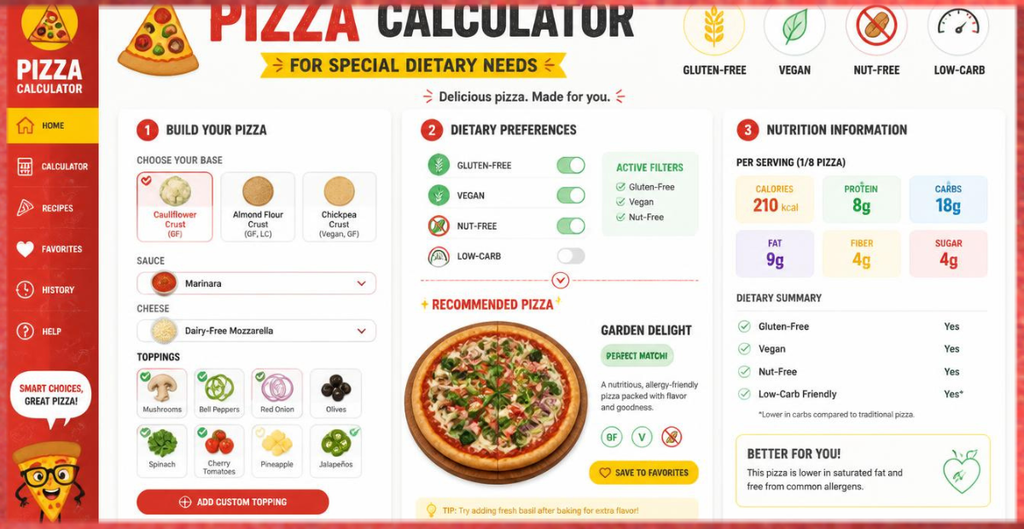
A successful pizza gathering isn’t only about quantity. It’s also about making sure everyone has something suitable to eat. Dietary requirements should be considered before placing the Group Pizza Order, not after the boxes arrive.
If someone needs Gluten-Free Pizza, check whether the Pizzeria prepares it separately and whether the kitchen can handle cross-contact concerns. Similarly, guests avoiding dairy may need a Dairy-Free Pizza with appropriate toppings and preparation.
You can divide the order into categories: regular pizzas for most guests, one or more dairy-free options, and a gluten-free option where necessary. Don’t assume a “vegetable pizza” automatically meets every dietary need, because cheese and sauces can contain ingredients guests are avoiding.
It may take one extra phone call, but thoughtful planning makes the meal feel much more welcoming. And honestly, nobody wants the guest with dietary restrictions eating plain lettuce while everybody else attacks the pepperoni.
Pizza and Sides: Should You Order Less?
Sides can change your Pizza Servings Estimate quite a bit. If your table includes Breadsticks, Salad, appetizers, Drinks, and Desserts, people may eat fewer pizza slices than they would if pizza were the only food.
A practical strategy is to estimate the pizza first, then reduce slightly if the sides are substantial. Don’t reduce too aggressively, though. Breadsticks are often eaten before pizza, beside pizza, and somehow after pizza too.
For a casual Family Gathering, pizza with salad and drinks may be plenty. For a larger event, you might also include wings, vegetables, fruit, or desserts. The best party food planning balances enough food with a reasonable amount of leftovers.
Leftover pizza isn’t exactly a tragedy anyway. Tomorrow’s breakfast has already introduced itself.
Ordering Pizza From a Pizzeria
Once you have your estimate, it’s time to decide where the pizza comes from. A local Pizzeria may offer different sizes, crust styles, toppings, and bundle options, so compare the actual menu before finalizing your order.
Look at Pizza Deals, especially when ordering multiple large pizzas. A bundle may provide better value than purchasing each pizza individually. At the same time, don’t choose a deal that gives you food nobody wants just because the price looks impressive.
For a large-volume order, ask about preparation time. A restaurant making twenty pizzas may need more notice than one making two. This is particularly important for events with a fixed start time.
And yes, confirm the address. Pizza Delivery becomes dramatically less useful when the driver arrives at the wrong building.
Pizza Delivery or Pizza Pickup?

Both Pizza Delivery and Pizza Pickup can work well, depending on the event. Delivery is convenient when you’re hosting and don’t want to abandon the guests, while pickup can sometimes reduce Delivery Fees or make timing easier.
For a large order, call ahead and ask how the restaurant handles big orders. Some pizzerias may recommend placing the order several hours earlier, especially during busy Friday evenings or major sporting events.
If you’re using Pizza Pickup, designate one person to collect everything and check the boxes before leaving. It’s a tiny task, but discovering that the gluten-free pizza stayed behind after you’ve returned to the party is not the sort of plot twist anybody requested.
A Simple Pizza Ordering Formula
You don’t need complicated mathematics to calculate pizzas needed. A simple method works for most everyday gatherings:
Step 1: Count the Adults.
Step 2: Count the Children.
Step 3: Estimate about 3 slices per adult and 2 slices per child.
Step 4: Determine how many slices your selected pizza provides.
Step 5: Divide the total estimated slices by the number of slices per pizza.
Step 6: Round upward when the result is not a whole number.
For example, eight adults and four children would be estimated at 24 adult slices plus 8 child slices, giving 32 slices. With eight slices per pizza, that comes to four pizzas.
If the group is especially hungry, or pizza is the only substantial food, adding another pizza may be sensible. If there are lots of sides, you may be comfortable with the base estimate.
This is essentially the pizza ordering formula in its most useful form: simple enough to remember and flexible enough for real people.
Pizza Calculator for Family Gatherings
A Pizza for Family Gathering situation can be pleasantly unpredictable. Grandparents may prefer smaller portions, teenagers may eat more than expected, younger children may take one bite and suddenly become interested in something else entirely.
For mixed-age groups, separating adults and children makes the pizza calculation formula more realistic. You can also ask whether pizza is the main meal or just one part of the gathering.
Family events often work nicely with a combination of large pizzas, a salad, drinks, and desserts. Having multiple toppings lets guests choose what they actually like rather than forcing everybody into one flavor.
A little variety can also make the table feel more generous. One classic cheese pizza, one meat option, one vegetable choice, and a specialty pizza can cover a surprising number of preferences.
How Pizza Calculators Help Avoid Waste
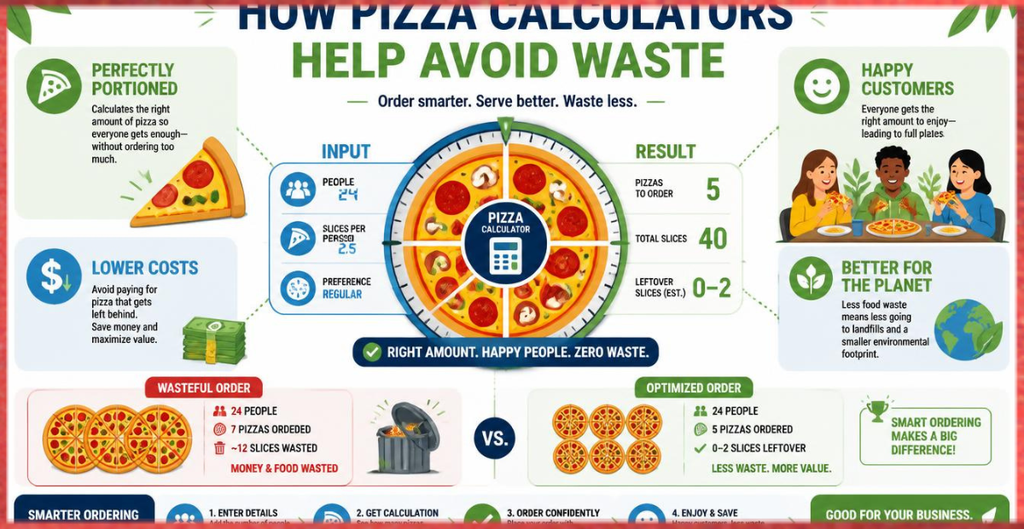
Nobody wants to run out of food, but ordering far too much can also become expensive. A pizza order calculator helps create a middle ground between panic-buying and heroic under-ordering.
The important thing is to remember that an estimate is not a guarantee. Appetite, pizza size, toppings, crust, age, meal timing, and side dishes all influence how much people eat.
If you’re unsure, consider the consequences. Running short at a large party is usually more inconvenient than having a few slices left over. Pizza reheats fairly well, and leftover slices can become tomorrow’s quick lunch.
In other words, a small safety margin isn’t wasteful planning. Sometimes it’s just good hosting.
Tips for Getting the Right Pizza Quantity
Before you finalize the Pizza Order, run through a few practical details. These little checks can save you from last-minute scrambling, which is especially useful when the guests have already arrived.
- Count Guests carefully, including children.
- Estimate Pizza Slices rather than relying only on pizza count.
- Consider the Hunger Level of the group.
- Check the actual Pizza Size offered by the restaurant.
- Remember that Thin Crust may be less filling than Deep Dish.
- Reduce the estimate slightly if you’re serving substantial sides.
- Include at least one suitable option for dietary restrictions.
- Check Pizza Deals for large orders.
- Confirm Delivery Fees before completing the purchase.
- Place large orders early when possible.
These steps sound almost too obvious, but obvious things are often what get forgotten when someone is trying to organize twenty hungry people at once.
Common Mistakes When Ordering Pizza
One of the biggest mistakes is assuming every pizza contains the same number of slices. A Standard Pizza might have eight slices, but another restaurant or size may offer a different cut.
Another mistake is ignoring children. Fourteen adults and six children shouldn’t necessarily be treated as twenty adults. The difference can become meaningful when the group is large.
People also sometimes focus too heavily on discounts. A fantastic Pizza Deal isn’t really a deal if half the toppings remain untouched in the boxes. Choose combinations that match the guests instead.
Finally, don’t forget the boring details: pickup time, delivery address, dietary needs, drinks, napkins, plates, and sauces. The pizza itself gets all the glory, but somebody still needs to remember the plates.
Making Your Pizza Order More Personal

A calculator gives you the quantity, but you can make the meal feel more thoughtful by matching the order to the people attending. Ask guests about favorite toppings before choosing the final combination, especially when the gathering includes different age groups.
For a birthday celebration, you might choose the guest of honor’s favorite pizza. For a family meal, include familiar classics alongside one adventurous flavor. For a Big Game, go heavier on easy-to-share options and add sides that don’t require everyone to sit down.
Even a simple note such as “I remembered you don’t eat dairy, so I ordered this one for you” can make someone feel genuinely considered. That’s the part no Pizza Calculator can calculate.
Frequently Asked Question
how many pizzas for 40 people
For 40 people, plan for about 15 large pizzas to provide enough slices for the group.
how many pizzas for 10 people
For 10 people, around 4 large pizzas should be enough, depending on hunger and whether you serve side dishes.
how many pizzas for 15 people
For 15 people, you’ll need approximately 6 large pizzas for a satisfying meal.
how many pizzas for 50 people
For 50 people, plan on about 19 large pizzas to comfortably feed everyone.
how many pizzas for 25 people
For 25 people, approximately 10 large pizzas should provide enough food for the group.
Read this blog https://avenzob.com/how-long-until-3-pm/
Final Thoughts on Using a Pizza Calculator
The best Pizza Calculator is not really about perfect mathematics. It’s about making a practical decision with enough confidence that you can stop worrying about food and start enjoying the people around you.
Use the number of Guests, separate Adults and Children, consider the Hunger Level, check the Crust Type, and pay attention to the actual pizza size. Then think about whether you’re serving pizza for Lunch, Dinner, a Birthday Party, a Family Picnic, or a casual Gathering.
The familiar 3/8 Ratio, the estimate of three slices per adult, and two slices per child, and the assumption of 8 10 slices per pizza can provide a useful starting point. But real parties aren’t machines, and appetite refuses to behave perfectly.
So calculate, adjust, and then relax a little. Order enough for everyone, add a sensible margin when needed, and remember that the real success of a pizza night isn’t the number printed on the calculator.
It’s the sound of people laughing around an open pizza box, reaching for another slice, and staying at the table just a little longer than planned.
And if you have your own trick for deciding how many pizzas to order, share it with others. Someone planning their next gathering will probably be very glad you did.