There is something quietly beautiful about watching a new day arrive. The first pale light slips across the horizon, birds begin making their little morning arguments, and suddenly the world feels as if it has been switched on again.
In Arlington, Texas, August mornings have their own particular rhythm, with the Sunrise arriving a little later as the month moves along and the evening Sunset gradually stepping backward. It is ordinary astronomy, really, but somehow it never feels completely ordinary.
And for families celebrating a new beginning, even something as simple as a sunrise can carry a little extra meaning. A newborn baby girl, for example, may make parents notice mornings differently.
A 6:54 a.m. sunrise can become the backdrop to a first feeding, a grandparent’s sleepy smile, or somebody whispering, “Look at her, she’s finally awake,” while everyone else is pretending they aren’t exhausted. Life gets funny like that.
This guide explores Arlington Texas sunrise and sunset times throughout August 2026, along with daylength, twilight, solar noon, sun direction, and practical ways to understand the changing sky.
The times are based on the City of Arlington, Texas, USA, and are given in local time, with Daylight Saving Time (DST) applied where appropriate. The published calculations also account for atmospheric refraction and use the Gregorian calendar.
| Date | Sunrise | Sunset | Daylength |
|---|---|---|---|
| Aug 1 | 6:42 AM | 8:26 PM | 13:44:05 |
| Aug 5 | 6:45 AM | 8:23 PM | 13:37:55 |
| Aug 10 | 6:48 AM | 8:18 PM | 13:29:44 |
| Aug 15 | 6:52 AM | 8:13 PM | 13:21:08 |
| Aug 20 | 6:55 AM | 8:07 PM | 13:12:11 |
| Aug 25 | 6:58 AM | 8:01 PM | 13:02:57 |
| Aug 31 | 7:02 AM | 7:54 PM | 12:51:34 |
Arlington Texas Sunrise and Sunset in August 2026
If you are searching for sunrise and sunset Arlington Texas, the most useful thing to remember is that August is not static. The Sun does not rise at exactly the same minute every morning, nor does it politely wait until the same evening hour to disappear.
At the beginning of the month, sunrise in Arlington is around 6:42 a.m., while sunset is around 8:26 p.m. By August 19, sunrise is 6:54 a.m. and sunset is 8:08 p.m. On August 31, sunrise reaches about 7:02 a.m., while sunset occurs around 7:54 p.m.
That means the Arlington daylight hours become noticeably shorter over the month. It is not dramatic from one day to the next, but stack those small changes together and August suddenly has a different evening personality.
The month begins with about 13 hours and 44 minutes of daylight and finishes with roughly 12 hours and 52 minutes. So, in just one month, Arlington loses nearly an hour of daylight.
For anyone looking for the August 2026 sunrise and sunset schedule, the following selected dates show the general pattern:
| Date | Sunrise | Sunset | Daylength |
|---|---|---|---|
| August 1 | 6:42 a.m. | 8:26 p.m. | 13h 43m 57s |
| August 5 | 6:45 a.m. | 8:23 p.m. | 13h 37m 47s |
| August 10 | 6:48 a.m. | 8:18 p.m. | 13h 29m 37s |
| August 15 | 6:52 a.m. | 8:13 p.m. | 13h 21m 02s |
| August 19 | 6:54 a.m. | 8:08 p.m. | 13h 13m 54s |
| August 20 | 6:55 a.m. | 8:07 p.m. | 13h 12m 06s |
| August 25 | 6:58 a.m. | 8:01 p.m. | 13h 02m 52s |
| August 31 | 7:02 a.m. | 7:54 p.m. | 12h 51m 30s |
These values come from the Arlington August 2026 solar table.
Arlington Texas Sunrise Time: What Changes During August?

The Arlington Texas sunrise time gradually moves later during August. On August 1, sunrise is approximately 6:42 a.m. By August 19, 2026, it is 6:54 a.m., and on August 20, it is 6:55 a.m. By the final day of the month, sunrise is around 7:02 a.m.
This slow movement is connected to Earth’s orbit, axial tilt, and the way apparent solar time interacts with the clock time used by people.
The Sun is following its celestial schedule; our clocks are following a civil-time system. They agree pretty well, but not perfectly, which is why solar noon is rarely exactly 12:00 p.m.
For early risers, the difference can actually be useful. Someone planning a morning walk, photography session, commute, outdoor workout, or quiet coffee on the porch may want to check the sunrise time August 2026 rather than simply assuming sunrise happens at the same time every day.
And if you are looking up sunrise today Arlington, make sure you use the correct date. A few minutes may sound tiny, but when you’re standing outside waiting for that first stripe of sunlight, three minutes can suddenly feel like seventeen. Funny how clocks behave when you’re waiting.
Arlington Texas Sunset Time and Evening Light
The Arlington Texas sunset time moves earlier throughout August. On August 1, sunset occurs around 8:26 p.m. By August 19 it is about 8:08 p.m., and by August 31 it is approximately 7:54 p.m.
So if you are checking sunset today Arlington, planning an outdoor family gathering, scheduling photographs, or simply trying to catch the last warm-looking light of the day, the exact date matters.
August evenings can still feel long, especially at the beginning of the month. But the calendar is quietly leaning toward September. The shortening day length in Arlington Texas is one of those seasonal changes that happens without asking anybody’s permission.
There is a pleasant little trick here: don’t think only about the moment of sunset. The sky often remains bright and colorful afterward because civil twilight continues after the Sun has dropped below the horizon. That extra period is useful for walking, photography, outdoor activities, and enjoying the evening without full darkness.
August 2026 Sun Schedule: A Month in Motion
The August 2026 sun schedule is almost like a slow-moving calendar written in light. Every day, the sunrise creeps later, sunset creeps earlier, and the total daylight duration becomes shorter.
At midmonth, the change becomes easier to notice. On August 15, Arlington has about 13 hours and 21 minutes of daylight. On August 19, the figure is about 13 hours and 14 minutes. On August 20, it drops to roughly 13 hours and 12 minutes.
The difference between August 19, 2026 and 20 Aug 2026 is only about 1 minute and 48 seconds of daylight, but that tiny change is a nice reminder that Earth’s seasonal clock never really stops.
For practical planning, a sunrise sunset calendar is much more useful than a single “sunrise today” value. A calendar lets you see the trend instead of just one moment.
Daylength in Arlington Texas

The daylength in Arlington Texas changes throughout the year because Earth is tilted on its axis. During summer, the Northern Hemisphere receives longer periods of sunlight. As the season progresses toward autumn, daylight decreases.
In August 2026, Arlington starts the month with approximately 13 hours and 44 minutes of daylight and ends it with about 12 hours and 52 minutes.
That is a reduction of roughly 52 minutes across the month.
The important distinction is that daylight is not the same thing as the entire period of useful outdoor brightness. Morning and evening twilight add additional light before sunrise and after sunset.
So when someone asks about hours of daylight, they usually mean the interval between sunrise and sunset. When someone asks about twilight times, they’re asking about the wider transition between day and night.
Civil Twilight, Nautical Twilight, and Astronomical Twilight
The sky does not simply jump from “day” to “night.” Nature apparently prefers transitions.
Civil twilight is the brightest twilight period and occurs immediately before sunrise and after sunset. It is often bright enough for many ordinary outdoor activities without artificial lighting.
Nautical twilight is darker. At this stage, the horizon is still distinguishable, but the sky has moved deeper toward night.
Astronomical twilight is darker still. Once astronomical twilight has ended, the sky reaches what is generally considered astronomical night, assuming local conditions are suitable.
For August 19 in Arlington, civil twilight begins around 6:29 a.m. and ends around 8:34 p.m. Nautical twilight runs roughly from 5:58 a.m. to 9:05 p.m., while astronomical twilight stretches from approximately 5:26 a.m. to 9:36 p.m.
This is why dawn and dusk are not technically the same as sunrise and sunset. There is a whole gradient in between, and it can be gorgeous.
Solar Noon Arlington and the Sun’s Highest Point
Solar noon Arlington does not occur at exactly 12:00 p.m. On August 19, the listed solar noon is approximately 1:32 p.m., with the Sun reaching an altitude of about 69.9 degrees. On August 20, solar noon is around 1:31 p.m., with a solar altitude near 69.6 degrees.
Why so late?
Because clock time is based on a time-zone system, while solar time depends on Earth’s rotation and Arlington’s longitude. Daylight Saving Time shifts the civil clock forward by one hour, too, so the Sun’s highest point can occur well after noon on the clock.
Solar noon is the moment when the Sun crosses the local solar meridian, the imaginary north-south line passing through the sky. It is a useful concept in solar position calculations, photography, solar-energy planning, and astronomy.
And no, solar noon isn’t the same as the hottest moment of the day. That is a separate story involving how land and atmosphere absorb and release heat.
Sun Direction and Sun Position Arlington Texas
The sun position Arlington Texas changes constantly. Around sunrise in mid-August, the Sun appears in the eastern part of the sky. Around sunset, it moves toward the west.
On August 19, the published sunrise direction is about 74 degrees, measured from true north, while sunset is around 285 degrees.
This is useful for people interested in sun direction, architecture, gardening, photography, or simply figuring out why one particular window suddenly becomes unbearably bright at 7:30 in the morning.
The Sun’s altitude also changes throughout the day. Near sunrise and sunset it is close to the horizon. Around solar noon it reaches its highest position for that day.
If you’re using a sun calculator, remember that geographic coordinates matter. A small location difference can produce slightly different sunrise, sunset, and solar-noon values.
Sun Distance From Earth in August

The Sun distance from Earth is not constant. Earth’s orbit is slightly elliptical, meaning the distance changes during the year.
The Arlington August 2026 table lists the Sun’s distance in millions of miles, decreasing from roughly 94.338 million miles on August 1 to about 93.825 million miles on August 31.
In kilometers, those values are approximately 151.8 million km and 151.0 million km, respectively.
That change does not explain the daily rise-and-set pattern by itself. Seasonal daylight is primarily driven by Earth’s axial tilt and the geometry of Earth’s orbit.
Distance does have an influence on the amount of solar energy Earth receives, but it is not the main reason August days become shorter in Arlington.Astronomy likes to make simple questions slightly complicated. That’s part of the charm, honestly.
Arlington Sun Times for August 19 and August 20, 2026
If you need a particularly precise reference for the current part of the month, August 19, 2026 has a sunrise at 6:54 a.m., sunset at 8:08 p.m., and approximately 13 hours, 14 minutes of daylight.
August 20, 2026 has sunrise at 6:55 a.m., sunset at 8:07 p.m., and about 13 hours, 12 minutes of daylight.The listed solar noon is about 1:32 p.m. on August 19 and 1:31 p.m. on August 20.
These values are more useful than copying a generic sunrise time from a different year. Solar events change from year to year, and local conditions and location definitions matter.
What About Moonrise, Moonset, and Moon Phases?
The Moon follows a different schedule from the Sun. Its Moonrise, Moonset, and phases shift from day to day, so a complete sky-watching plan should include both solar and lunar information.
For people interested in moonrise Arlington, moonset Arlington, or moon phases Arlington, a dedicated lunar calendar is preferable because moonrise and moonset can vary substantially between consecutive dates.
The same goes for eclipses. An eclipse is a specific astronomical event, not simply another phase of the Moon. August 2026 is especially interesting for skywatchers, with major celestial events featured in astronomy guides for the month.
For a beginner, the best approach is wonderfully simple: find a dark location, look up, and give your eyes several minutes to adjust. The night sky Arlington may look surprisingly different once city lights become less dominant.
Arlington Texas Astronomy and the Autumnal Equinox
August is still firmly connected with summer, but the calendar is already pointing toward autumn.
The Autumnal equinox occurs on September 22, 2026. For Arlington, the published astronomical timing is about 7:05 p.m. local time.
The equinox is the point when the Sun crosses the celestial equator moving southward, marking the beginning of astronomical autumn in the Northern Hemisphere.
It is also why searches for autumnal equinox 2026, September equinox, and equinox September 2026 often appear alongside late-summer sunrise and sunset information.
But don’t expect exactly 12 hours of daylight and 12 hours of darkness on the equinox itself at every location. Atmospheric refraction and the way sunrise and sunset are defined affect the actual measured daylength.
Why Sunrise and Sunset Times Are Not Exactly “Equal” Every Day
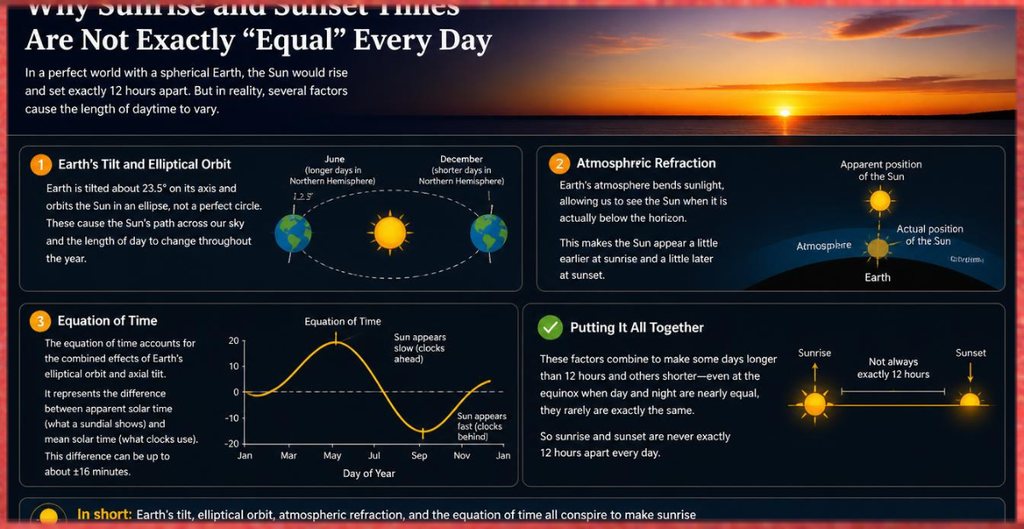
A common assumption is that sunrise should move later by the same number of minutes each day. It doesn’t.
The daily change varies because Earth’s orbit is not a perfect circle and because the Earth’s rotational axis is tilted. The combination affects the relationship between solar time and clock time.
This is why the sunrise sunset times August 2026 table shows slightly different daily changes. One day may lose a minute and a half of daylight, another nearly two minutes.
The numbers seem small, but over weeks they become obvious.That’s the funny thing about astronomy: enormous systems create tiny changes that humans can actually notice.
How to Use an Arlington Sunrise Sunset Calendar
A sunrise sunset calendar Arlington can be useful for much more than checking whether you need to wake up early.
You can use it for:
- Planning outdoor photography around golden-hour light.
- Choosing the best time for a morning walk.
- Organizing outdoor family gatherings.
- Estimating when natural light will disappear.
- Planning gardening and yard work.
- Understanding seasonal changes.
- Preparing for camping or evening activities.
- Studying basic astronomy.
- Tracking how quickly daylight changes.
- Comparing summer and autumn daylight hours.
For exact planning, use the date-specific local time rather than a monthly average. The Arlington August table provides daily rise/set times, daylength, twilight periods, and solar-noon information.
A Few Things That Can Change What You Actually See
Calculated sunrise is not a guarantee that the Sun will be visually obvious at that exact second. Clouds, haze, buildings, trees, hills, and atmospheric conditions can all affect what you see.
The calculations account for refraction, which is important because Earth’s atmosphere bends light near the horizon.
Your personal view can still differ. Someone standing on a rooftop may see the Sun earlier than someone surrounded by tall buildings or trees.
So if a website says 6:54 a.m. and your neighborhood doesn’t look sunny until 6:57, astronomy has not broken. Your local horizon is simply being itself.
A Human Way to Think About Daylength
Numbers are useful, but sometimes they don’t tell the whole story.
Think of August 1 as a long hallway filled with light. By August 31, the hallway is still bright, but the lights are switching off a little earlier each evening. Nothing dramatic happens at one exact moment. The season simply keeps moving.
That is why daylight length Arlington is more interesting when viewed as a trend.
The difference between one day and the next can be easy to ignore. The difference between August 1 and August 31 is much harder to miss.And perhaps that is a nice lesson for everyday life too. Big changes are often just many tiny changes wearing a trench coat.
How to Write a Personal Note About an Arlington Sunrise

If you’re using an Arlington sunrise as part of a card, social post, family announcement, or personal message, don’t make it sound like a weather report.
Instead of writing something generic, connect the sky to the person or moment.
For a family welcoming a baby girl, you might write:
“On a warm August morning in Arlington, the Sun rose like it had somewhere important to be and so did our hearts. Welcome, little girl.”
Or keep it simpler:
“The morning light over Arlington feels a little brighter today. Maybe that’s because someone very special has arrived.”
A good message does not need complicated poetry. Sometimes two honest sentences beat a whole paragraph of fancy words.
Warm Newborn Blessings Inspired by Sunrise
Welcoming a daughter often gives families a new reason to notice ordinary moments. A sunrise becomes a symbol of beginning, hope, patience, and possibility.
Here are some adaptable wishes:
- May your little girl grow beneath bright mornings and peaceful skies, surrounded by people who love her fiercely.
- May every sunrise bring your family another reason to smile, even on those mornings when nobody got enough sleep.
- Congratulations on welcoming your beautiful daughter; may her life be filled with kindness, courage, laughter, and wonder.
- May your baby girl bring the kind of happiness that quietly changes an entire home.
- Wishing your growing family countless beautiful mornings, messy breakfasts, tiny giggles, and memories you never planned to make.
- May she always know that she was welcomed into this world with enormous love.
- May your daughter grow into someone who carries warmth into every room she enters.
- Congratulations on this precious new beginning; may parenthood surprise you in all the best ways.
- May your little girl have a childhood full of safe arms, curious questions, muddy shoes, and unforgettable adventures.
- Like the morning Sun, may she bring warmth wherever her life takes her.
These kinds of messages work because they are personal without being overly specific. Add the baby’s name, birth date, or a small family detail and the message becomes yours.
Why a Baby Girl and a New Sunrise Make Such a Natural Pair
There is an emotional reason sunrise imagery appears so often in newborn messages. Both represent beginnings.
A sunrise does not promise that the entire day will be easy. It simply says the day has arrived, and there is another chance to begin.Parenthood is a little like that.
A new baby can bring excitement, nervousness, exhaustion, laughter, and the occasional moment where someone looks at the clock and wonders how it became 01:32 already. Those emotions can all exist together.
That is why a message about welcoming a daughter does not need to pretend everything is perfect. The most genuine congratulations often acknowledge the beautiful messiness of real family life.
Practical Tips for Checking Arlington Sun Times
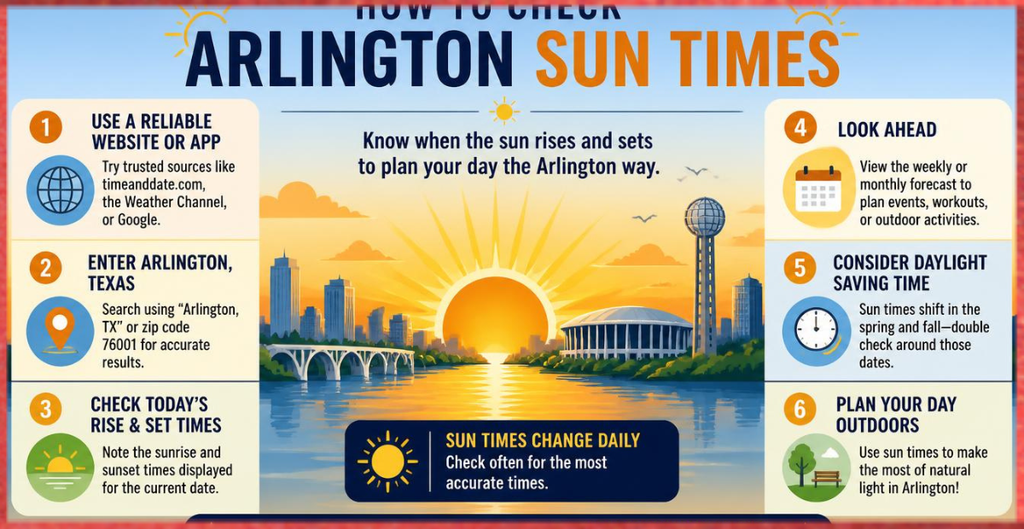
When checking Arlington sun times, keep these points in mind:
- Use the exact date rather than a generic seasonal estimate.
- Confirm that the location is Arlington, Texas, rather than another Arlington.
- Check whether the displayed time is local time.
- Remember that DST-adjusted time is already reflected in published local solar tables when applicable.
- Distinguish sunrise from civil dawn.
- Distinguish sunset from civil dusk.
- Use solar noon if you need the Sun’s highest daily position.
- Consider your actual horizon because buildings and trees can block the Sun.
- For astronomy, check Moon information separately.
- For long-term planning, compare several dates rather than relying on one number.
The published Arlington table explicitly notes that its times are local, adjusted for DST when applicable, corrected for refraction, and based on the Gregorian calendar.
Frequently Asked Question
sunset arlington tx
The sunset Arlington TX time changes throughout the year, with August 2026 sunsets gradually becoming earlier as summer moves toward fall. On August 19, sunset is around 8:08 PM local time.
Read this blog https://avenzob.com/10-weeks-from-today/
Final Thoughts on Arlington’s August Sky
The Arlington Texas sunrise and sunset schedule for August 2026 tells a small seasonal story. Sunrise moves from about 6:42 a.m. at the beginning of the month to around 7:02 a.m. at the end. Sunset shifts from roughly 8:26 p.m. to 7:54 p.m., while daylight decreases from about 13 hours and 44 minutes to 12 hours and 52 minutes.
On August 19, 2026, Arlington has about 13 hours, 14 minutes of daylight, with sunrise at 6:54 a.m. and sunset at 8:08 p.m. The following day, August 20, 2026, daylight is about 13 hours, 12 minutes.
Those numbers may look purely practical, but they can become surprisingly personal. A sunrise might mark a first morning with a newborn daughter. A sunset might frame a family dinner. A little twilight might be the perfect moment for a walk, a photograph, or five quiet minutes before bedtime.
And that’s perhaps the loveliest thing about watching the sky: the Sun follows enormous astronomical rules, yet every person experiences its light in a completely different way.
So whether you’re searching for Sunrise today Arlington, planning around the sunrise sunset calendar, studying Arlington Texas astronomy, or simply waiting for tomorrow morning to arrive, take a second to look up.The Sun will rise.The day will begin.And sometimes, that is more than enough reason to feel hopeful.