There are days that arrive quietly, and then there are days that seem to knock on the heart’s door before breakfast. Valentine’s Day is one of those days.
Every year on February 14, people pause their ordinary routines to say something they may have felt for months but never quite found the courage or the right words to say.
Sometimes that message is for a husband or wife, sometimes for a new crush, a lifelong friend, a parent, or simply someone who made a difficult year feel a little less heavy.
The modern celebration can look wonderfully different from one person to another. For some lovers, it means dinner, red roses, Valentine’s Day gifts, and a handwritten card.
For others, it means sharing chocolates with friends, calling family, or sending a silly message at midnight. Thats part of its charm: love does not come in one size.
Whether you are searching for the meaning of Valentine’s Day, wondering what day is Valentine’s Day, planning a thoughtful surprise, or simply looking for words that don’t sound copied from a greeting-card aisle, this guide explores the history, traditions, emotions, and many ways to celebrate this familiar but surprisingly complicated holiday.
| Year | Valentine’s Day | Day |
|---|---|---|
| 2026 | February 14, 2026 | Saturday |
| 2027 | February 14, 2027 | Sunday |
| 2028 | February 14, 2028 | Monday |
| 2029 | February 14, 2029 | Wednesday |
| 2030 | February 14, 2030 | Thursday |
What Is Valentine’s Day Really About?

At its heart, Valentine’s Day is a celebration of affection, connection, and appreciation. Although it is strongly associated with romantic love, the day can also celebrate love and friendship, family bonds, kindness, and the people who quietly make life better.
The holiday has religious and cultural layers, but the modern version is largely a secular celebration. Historically, St. Valentine’s Day was a Christian feast associated with a martyr named Valentine, while the romantic meaning developed much later.
So if someone asks, “What is Valentine’s Day about?” the honest answer is a little bigger than roses and heart-shaped candy. It is about making affection visible. And honestly, we could probably use more days like that.
Valentine’s Day History: From Saint Valentine to Romantic Tradition
The Valentine’s Day history is filled with uncertainty, legends, religious traditions, poetry, and later commercial customs. There may have been several Christian martyrs named Valentine, which makes the identity of the saint behind the celebration difficult to pin down.
One tradition connects Saint Valentine of Rome with a Christian priest who lived during the reign of Roman Emperor Claudius II.
Another story connects the feast with Saint Valentine of Terni, a bishop who was also believed to have been martyred. Historical evidence does not allow us to confidently merge all these stories into one biography.
The connection between the saint and romance came much later. Geoffrey Chaucer, in The Parliament of Fowls, helped establish the association between Saint Valentine and romantic love in medieval literature.
His poem imagined birds choosing their mates around St. Valentine’s Day, helping give the date its romantic atmosphere.
That is a rather poetic way for a holiday to grow, isnt it? A martyr, a poem, springtime symbolism, and centuries of human beings deciding they should probably send somebody a card.
Why Is Valentine’s Day on February 14?
If you’ve ever wondered why Valentine’s Day is February 14, the answer involves Christian history and medieval traditions.
Pope Gelasius I established February 14 as the feast of St. Valentine in the late fifth century, traditionally dated to A.D. 496. The feast honored a Christian martyr rather than originally celebrating romantic relationships.
The romantic interpretation developed centuries afterward. Medieval ideas about spring, birds choosing mates, courtly love, and poetry gradually transformed February 14 holiday traditions into something much closer to today’s celebration.
So, Valentine’s Day February 14 isn’t simply a modern marketing invention. Its history is layered, and some parts are much older than the chocolates sitting on supermarket shelves today.
Valentine’s Day 2026 and Valentine’s Day 2027
For people planning ahead, Valentine’s Day 2026 falls on Saturday, February 14, 2026.
Valentine’s Day 2027 will fall on Sunday, February 14, 2027. That makes it easy to remember: the date itself does not change, only the day of the week does.
If you’re searching “when is Valentine’s Day 2026,” “Valentine’s Day date 2026,” or “Valentine’s Day 2027,” the answer is February 14 in each year. The more interesting question, perhaps, is what you’ll do with the day once it arrives.
The Lupercalia Connection: Fact, Theory, or Myth?

A popular explanation for the origins of Valentine’s Day connects it with Lupercalia, an ancient Roman festival traditionally associated with fertility and purification. It was held around February 15 and included rituals connected with the Roman world.
The festival has sometimes been described as a Roman pagan festival honoring Lupercus, sometimes identified in modern explanations as a God of Fertility.
But the claim that Valentine’s Day simply replaced Lupercalia is much less certain than social media posts sometimes make it sound. Modern historians point out that direct evidence connecting the two holidays is weak.
So the Lupercalia festival belongs in the history conversation, but it shouldn’t be presented as a proven one-to-one origin of Valentine’s Day. History, annoyingly and wonderfully, refuses to stay simple.
How Love Letters Became Valentine Cards
Long before phones made a romantic message almost too easy, people wrote.
One famous early example comes from Charles Duke of Orleans, who wrote a Valentine poem to his wife while imprisoned in the Tower of London in 1415.
Written Valentines became increasingly popular over the centuries, eventually developing into the elaborate Valentine cards associated with the Victorian era.
During the Victorian era, people became especially creative with paper, lace, flowers, poetry, illustrations, cherubs, Cupid, and decorative symbols. A card could say what ordinary conversation sometimes couldn’t.
Today, digital messages have replaced much of that tradition, but a handwritten card still feels different. It has fingerprints, imperfect handwriting, and maybe a coffee stain. Somehow those little flaws make it more human.
Valentine’s Day Gifts That Actually Feel Personal
A good gift does not have to be expensive. In fact, the best Valentine’s Day gifts often show that someone was paying attention.
Here are a few ideas that can be adapted to different relationships:
- A handwritten letter describing one memory you never want to forget.
- A small photo album filled with ordinary moments rather than only perfect pictures.
- A favorite book with a personal note written inside the cover.
- Homemade Valentine’s Day chocolates or a dessert connected to a shared memory.
- A simple bouquet of flowers chosen because of the person’s favorite color.
- A playlist containing songs that tell the story of your relationship.
- A planned day together instead of a wrapped object.
- A small personalized keepsake that references an inside joke.
- A breakfast made at home, especially if your partner usually does the cooking.
- A “reasons I love/appreciate you” jar filled with tiny handwritten notes.
The trick is noticing the person rather than noticing the price tag. That’s where meaningful romantic gifts usually begin.
Valentine’s Day Messages for a Husband or Wife
A romantic message doesn’t need to sound like it escaped from a movie. Actually, it may be sweeter when it sounds like you.
- Happy Valentine’s Day to the person who makes ordinary Tuesdays feel like something worth remembering.
- I would choose you again, in every version of this life, even the messy bits.
- You are my favorite person to come home to, laugh with, and occasionally annoy for no reason.
- Thank you for being my safe place, my teammate, and the person who knows my strange habits by heart.
- Loving you has taught me that true love is less about perfect moments and more about staying through ordinary ones.
- I don’t need a perfect date night when sitting beside you already feels like enough.
- Happy Valentine’s Day to the one who somehow makes my world feel both calmer and more exciting.
- If I had to write our whole story again, I’d still keep your name on every page.
- Thank you for all the tiny things you do that nobody else notices but I never forget.
- You are not just my Valentine; you are one of the best parts of my everyday life.
Valentine’s Day Wishes for a New Relationship
New love has its own kind of electricity. Everything feels slightly brighter, and even a short text can be reread six times. Very scientific, obviously.
- Happy Valentine’s Day! I’m really glad our paths crossed.
- Here’s to the beginning of something lovely, unexpected, and hopefully a little bit crazy.
- I don’t know exactly where this story goes, but I like where we’re starting.
- You have made this season of my life much more exciting.
- Happy Valentine’s Day to someone who has become surprisingly important to me.
- I hope today gives us another memory worth smiling about later.
- Meeting you was one of those small moments that ended up changing much more than I expected.
- Here’s to new memories, long conversations, terrible jokes, and whatever comes next.
- I like you more than I planned to, and honestly, I’m not complaining.
- May our new chapter be filled with laughter, honesty, kindness, and plenty of reasons to stay curious about each other.
Valentine’s Day Wishes for Friends and Family
Not every Valentine needs to be romantic. Love and friendship are powerful enough reasons to celebrate, and sometimes the person who deserves a message most is the friend who stayed when everything else was falling apart.
- Happy Valentine’s Day to a friend who makes difficult days easier.
- Sending you a little extra love today because you deserve to know how appreciated you are.
- Some people bring flowers; you bring laughter, advice, and perfectly timed nonsense. Thank you.
- Happy Valentine’s Day to one of the people who makes life feel less lonely.
- Friendship like ours deserves more than one day of appreciation, but I’ll gladly start here.
- Thank you for being the person I can call without rehearsing what I’m going to say.
- Sending warm wishes to my favorite kind of human: loyal, funny, and slightly unpredictable.
- Happy Valentine’s Day to my family, my first home, and my forever people.
- Love isn’t always romantic. Sometimes it looks like checking in, showing up, and remembering the little things.
- Wishing you a February 14 filled with the people who make your heart feel at home.
Funny Valentine’s Day Messages
Romance is beautiful, but sometimes the most accurate declaration of love is simply admitting that you’d share your fries.
- Happy Valentine’s Day! I love you almost as much as I love snacks.
- You are my favorite person to do absolutely nothing with.
- Roses are red, chocolates are sweet, and somehow you still tolerate me.
- I would share my dessert with you, which should be considered a legally binding declaration of love.
- Happy Valentine’s Day to the person who knows all my weird habits and hasn’t escaped yet.
- You’re the Wi-Fi to my emotional stability. Please don’t disconnect.
- I love you even when you say “I’m fine” in that very obviously not-fine voice.
- Our love may not be perfect, but at least we’re consistently weird together.
- You’re my favorite notification.
- Happy Valentine’s Day. I still like you, so I guess we’re doing pretty good.
Poetic Valentine’s Day Wishes
Sometimes plain sentences aren’t enough. A short love poem can make a message feel like something kept rather than something quickly read.
- You are the quiet morning after a noisy night, the little peace I didn’t know I needed.
- If love had a sound, I think it would be your laughter filling an ordinary room.
- Among all the roads life could have taken, I’m grateful one of them brought me to you.
- You turned simple moments into memories I carry without even trying.
- Let February pass, let seasons change; some kinds of love don’t need a calendar.
- You are the page I never want to turn too quickly.
- In a world full of passing moments, you became one I wanted to stay inside.
- If hearts could keep photographs, mine would be crowded with you.
- Love is sometimes loud, but with you, it can also be the comfort of sitting quietly together.
- Today I send you words, but tomorrow and every ordinary day, I hope I show you what they mean.
Valentine’s Day Traditions Around the World
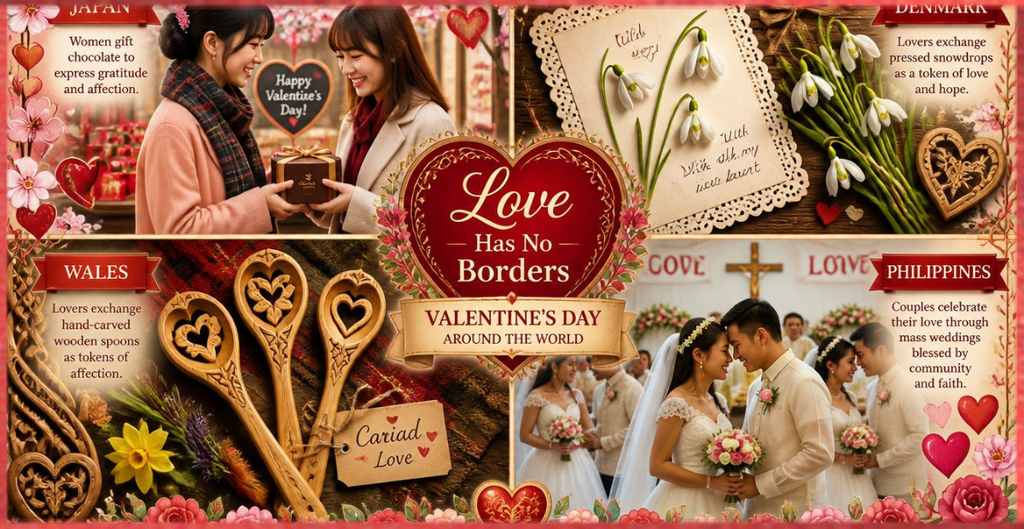
The idea of a worldwide global celebration of love is real, but the traditions are wonderfully varied. Valentine’s Day around the world does not look identical everywhere.
In South Korea, Valentine’s Day is part of a broader sequence of romantic observances. Women traditionally give gifts to men on February 14, while White Day March 14 provides an opportunity for men to reciprocate.
Black Day April 14 has developed as a day associated with single people. The pattern is quite different from the one-day model familiar in many Western countries.
In Brazil, the romantic celebration is known as Dia de São Valentim in some contexts, but Brazil traditionally celebrates Dia dos Namorados on June 12, rather than February 14. This is an excellent reminder that Valentine’s customs aren’t universal just because Valentine’s branding is.
In Colombia, a major romantic celebration known as Día del Amor y Amistad emphasizes both love and friendship and is traditionally observed in September.
In Argentina, the Week of Sweetness, or La Semana de la Dulzura, has become associated with exchanging sweets and affection. These traditions show how the basic idea of expressing appreciation can be reshaped by local culture.
Valentine’s Day in China and Other Love Festivals
China has its own famous romantic tradition: Qixi Festival, also called the Double Seventh Festival. The story centers on Niulang and Zhinü, two lovers separated by the Milky Way and permitted to meet once a year.
The legend has roots in Chinese cultural history and is sometimes connected with traditions extending back many centuries, including the Han Dynasty. Modern celebrations may include romantic dinners, gifts, and expressions of affection, giving the ancient story a surprisingly modern life.
In Israel, Tu B’Av is often described as a Jewish festival associated with love. Its date follows the Jewish calendar, so it does not correspond to February 14.
Meanwhile, in Wales, Saint Dwynwen is associated with Welsh expressions of love, traditionally celebrated on January 25. Welsh love spoons have become a particularly recognizable symbol of affection.The point isn’t that one tradition is better. It’s that people everywhere keep inventing their own language for tenderness.
Valentine’s Day in India
In India, Valentine’s Day Week has become especially visible in popular culture, particularly among younger people. The week may include Rose Day, Propose Day, Chocolate Day, Teddy Day, Promise Day, Hug Day, and Kiss Day, leading up to February 14.
These labels are largely modern commercial and popular-culture traditions rather than ancient religious observances. Still, they have created a playful countdown toward Valentine’s Day for many young people.
A person might begin with a rose, follow it with chocolate, add a promise, and eventually arrive at the main celebration. It’s a whole little romantic calendar packed into one week which is either adorable or exhausting, depending on your budget.
Is Valentine’s Day a Christian Holiday?
Historically, Valentine’s Day Christianity is connected to the feast of a Christian martyr. The Roman Catholic tradition honored St. Valentine, and the date became part of the Christian calendar.
However, modern Valentine’s Day is generally a secular holiday focused on romance, friendship, gifts, and social celebration. Different Christian denominations, including communities within the Anglican Communion, Lutheran Churches, Eastern Orthodox, and Catholic Churches, may approach the observance differently.
It is useful to distinguish the historical feast from today’s commercial and cultural celebration. The Bible does not specifically establish Valentine’s Day, and the modern romantic customs developed long after the earliest Christian traditions.
Cupid, Flowers, Chocolates, and the Symbols of Love
Why do Cupid, hearts, love birds, roses, and chocolates appear everywhere in February?
Cupid comes from Roman mythology, where he is associated with love and desire. The cherub-like version commonly shown on cards became especially popular in later European art and commercial imagery.
Flowers, especially red roses, became powerful romantic symbols because roses had long associations with beauty and love. Meanwhile, decorated greeting cards turned Valentine’s Day into an opportunity for elaborate visual expression.
Chocolate eventually joined the party in a very serious way. In the 19th century, chocolate makers helped popularize Valentine’s Day confectionery, and the tradition of giving chocolate in decorative boxes became closely tied to the celebration.
Richard Cadbury is often credited with developing an early heart-shaped chocolate box in the Victorian era.Today, a box of chocolates can say “I love you,” “I remembered,” or occasionally “I had no idea what else to buy.” Context matters.
Creative Ways to Celebrate Valentine’s Day
A memorable Valentine’s celebration does not need a restaurant reservation or an expensive gift. Sometimes the most meaningful plan is almost embarrassingly simple.
Try a home-cooked dinner where each person chooses one dish. Have a movie night with phones in another room. Write Valentine’s letters to each other and read them aloud. Recreate your first date.
Make a small memory box. Go for a walk and buy each other something inexpensive that reminds you of the other person.
For couples who enjoy date nights, the best idea may be choosing an experience over an object. Cook together, take a short road trip, visit a museum, have breakfast at midnight, or make a list of ten places you want to visit together.
And if you’re single? Celebrate anyway. Invite friends over, call someone you love, buy yourself flowers, or make the evening deliberately peaceful. A day of love does not require you to be romantically partnered.
How to Write a Personal Valentine’s Day Message
The easiest way to make a message feel genuine is to stop trying to sound impressive.Start with the person’s name. Mention one specific memory. Say what you appreciate. Then add a hope for the future.
Instead of writing, “You are the love of my life,” try something like: “I still laugh when I remember us getting completely lost on that rainy afternoon, because somehow that terrible day became one of my favorite memories.”
Specific details create emotional weight. A generic sentence can be beautiful, but a sentence that could only belong to your relationship is much harder to forget.You can also combine a ready-made wish with your own detail. For example:
“Happy Valentine’s Day. I love you more than words can explain, but I especially love the way you always make me laugh when I’m stressed. I hope we have a hundred more ordinary evenings like that.”That sounds human. It doesn’t need fireworks.
Is Valentine’s Day a Public Holiday?
One common question is whether Valentine’s Day is a public holiday. In many countries, February 14 is observed culturally rather than as a nationwide day off work or school. Being a popular Valentine’s Day holiday does not automatically make it a legal public holiday.
That distinction matters because people may celebrate with cards, dinners, flowers, and gifts while still going to work or school as usual.
The holiday’s social importance and its legal status are two different things. Romance, apparently, does not always come with paid leave.
The Many Meanings of Saint Valentine

The story of Saint Valentine is surrounded by legends. He has been described as a priest, a bishop, a protector of couples, and a martyr. Some traditions connect him with secret marriages under Roman Emperor Claudius II, while other stories describe him helping a blind girl. Historians caution that these popular accounts are difficult to verify.
Interestingly, St. Valentine has been associated not only with lovers but also with young people, beekeepers, and people affected by epilepsy. He has even been linked historically with the term Valentine’s Malady.
So the saint behind the holiday is far more complicated than the cartoon figure holding a heart. Maybe that’s fitting. Human love is complicated too.
Frequently Asked Question
valentine’s day
Valentine’s Day is celebrated every year on February 14 as a day to express love, affection, and appreciation for special people.
valentine day
Valentine Day is another common way of referring to Valentine’s Day, often celebrated with romantic messages, gifts, flowers, and chocolates.
वेलेंटाइन डे लिस्ट
वेलेंटाइन डे लिस्ट में रोज डे, प्रपोज डे, चॉकलेट डे, टेडी डे और अन्य खास दिनों को शामिल किया जाता है।
वैलेंटाइन डे
वैलेंटाइन डे हर साल 14 फरवरी को मनाया जाता है और यह प्यार, दोस्ती और रिश्तों की अहमियत जताने का अवसर है।
valentine de kab hai
Valentine Day कब है? Valentine’s Day हर साल 14 फरवरी को मनाया जाता है।
Read This blog https://avenzob.com/what-time-is-30-minutes-from-now-the-ultimate-30-minutes-calculator/
Final Thoughts on Valentine’s Day
Valentine’s Day has traveled a remarkably long road from a Christian feast associated with a mysterious martyr, through medieval poetry and English folk customs, into the Victorian world of cards and chocolates, and finally into today’s digital age of instant messages and carefully staged photographs.
Yet the central impulse hasn’t changed much: people want to tell other people that they matter.Whether you celebrate with Valentine’s Day cards, flowers, heart-shaped chocolates, a handwritten Valentine poem, a quiet conversation, or simply a sincere “I’m glad you’re in my life,” the gesture matters more when it feels personal.
You don’t need the biggest bouquet. You don’t need the most expensive restaurant. You don’t even need a romantic partner.Sometimes Valentine’s Day is simply a reminder to stop for a moment and say the thing we postpone too often: I appreciate you. I remember you. I love having you in my life.And really, thats a pretty lovely reason to keep February 14 on the calendar.